Happy Little Clouds
Seattle is getting dosed with Magic, Luck, and Friendship in an installation designed to get your mind out of the gutter of glum
Loading…
Happy Little Clouds
Seattle is getting dosed with Magic, Luck, and Friendship in an installation designed to get your mind out of the gutter of glum
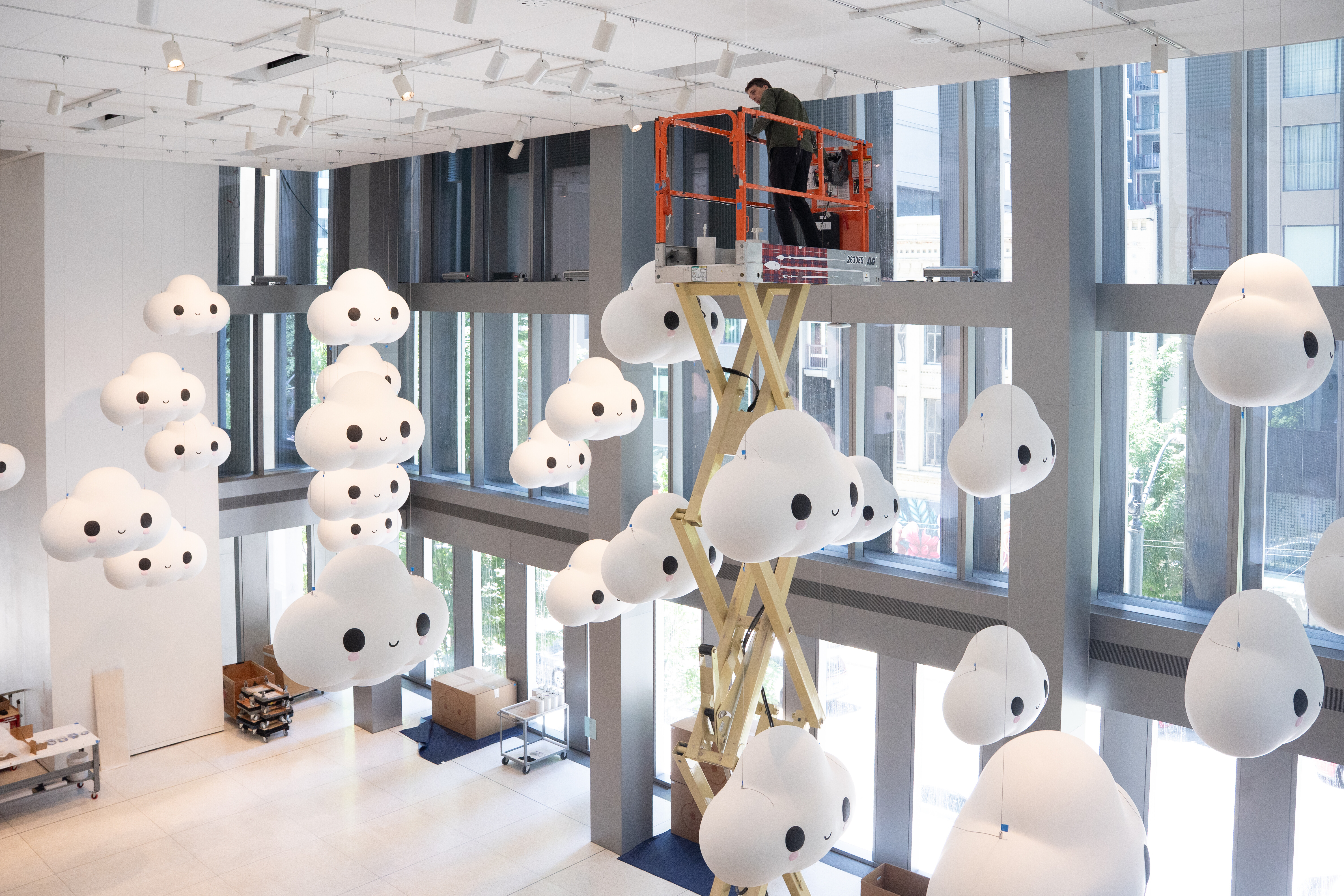
It’s a bird, it’s a plane…it’s an army of 40 adorable, rosy-cheeked clouds currently smiling down on visitors as they pass through Seattle Art Museum’s main entrance lobby (a.k.a. the Brotman Forum).
The cloudy sky taking up cheerful formation, titled Little Cloud Sky, is a commission created by FriendsWithYou, the LA-based collaborative duo of Samuel Albert Borkson and Arturo Sandoval III (Sam and Tury for short). Little Cloud Sky replaces the recently-departed Middlefork, the beloved sculpture by local artist John Grade, who built it with nearly one million segments of reclaimed old-growth cedar pieced together to recreate the exact shape of an actual 150-year-old western hemlock tree growing in the Cascade Mountains.
Before Middlefork, the airspace at SAM was filled with Cai Guo-Qiang’s Inopportune: Stage One, an installation originally installed at the Guggenheim in 2008 and adapted for the Brotman Forum, consisting of nine white Ford Taurus cars suspended, spiraling, and flipping mid-air, each vehicle pierced by radiant spears of light spoking out. Sort of like the world’s most elaborate Sputnik chandelier. But now (and through June 2028), it's all about the clouds.
"Magic, Luck, and Friendship" is the mantra-motto of FriendsWithYou. Yet, one can’t help but wonder, are these cumulus cuties really the best work of art to reflect the current state of the things...with the world being chronically on fire, both literally and metaphorically?
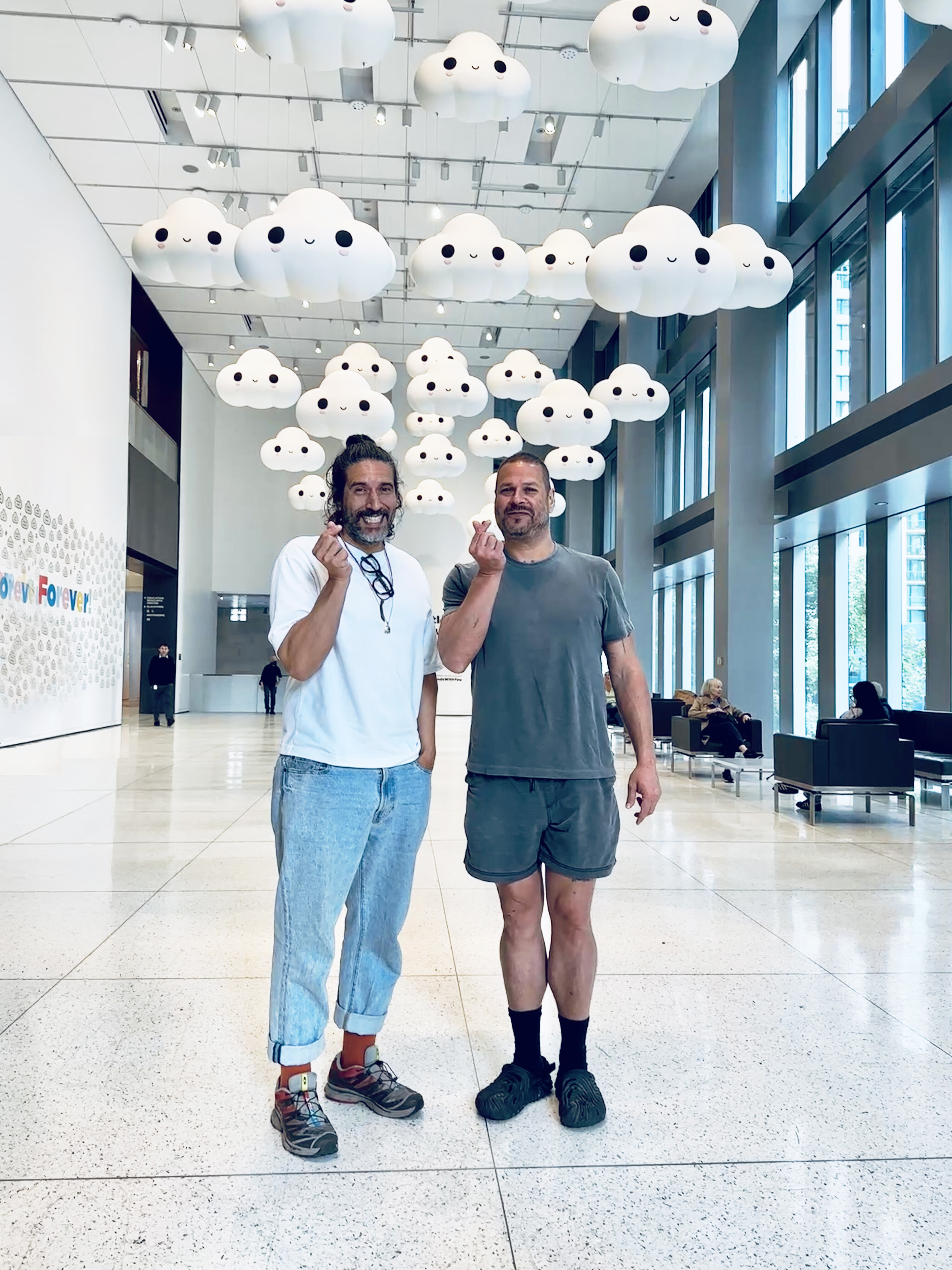
Last Friday we got the chance to sit down with the affable duo, both dressed for the occasion in unassuming sneakers and t-shirts. As we chilled beneath the installation, we discussed why cloudy skies ahead might be a good thing.
PDA: How long have you been together?
Sam and Tury: 25 years now!
PDA: What's the origin story of FriendsWithYou?
Sam: We were kind of ravers, you know—our hippie movement—so we were just friends through dancing and partying. And we shared sketchbooks with each other. What was interesting was that both our sketchbooks were experiential in similar ways, filled with things like animations and ideas for 3-D sculptures or weird characters and stuff. We were like,this is kinda strange; let’s hang out and play with toys and look at design books and art books together!
PDA: Did you start by manufacturing toys?
Sam: Around 2001, before the whole art toy thing was happening, we were asking ourselves, how do you make art for a larger grouping of people? We started FriendsWithYou because we were starting to see a bigger isolation happening amongst humans. We were becoming more computerized and isolated. So we were like, okay, we need to make an antidote for this. So we created these plush dolls—weird plush toys that you can hug and hang out with. They were amulets to empower their user, to help them. It kind of goes with our core belief that, as we nurture ourselves, we nurture the garden, you know? Each person an individual little flower.
PDA: Have clouds always been in your work—it's not just a Seattle thing?
Sam: They've been somehow involved in our visual language since the beginning. A key idea behind our work is this idea of animism, like bringing an imbued anima to the natural world. The cloud was always part of that arrangement, but it became a recurring symbol—a symbol for levity, for not taking yourself too serious. This idea of embracing joy, countering the false idea that maturity has to do with seriousness.
PDA: The feeling of your head in the clouds...
Tury: With what's about to happen with AI, the only thing that we're going to have left is our head in the cloud! Our work is going to be when we transcend rational thinking. Rational thinking is going to be outsourced to the computer altogether soon.
PDA: So we need to connect more to the ability to have our heads in the cloud...
Tury: I think so. The ability to connect with that which transcends the seriousness of rationality. The structural framework of the rational is, to some degree, wrongly represented as something to be valued. More and more the irrationality of childhood and the irrationality of play is going to become more important, and more interesting than the rational.
PDA: Do you guys think about AI a lot in relation to your work?
Tury: All the time. I'm amazed that we're not all thinking and talking about it more. It's going to change everything. It is changing everything.
PDA: It feels like we're living inside a sci-fi book right now.
Tury: 100%. And it's going to be freaky when the robots show up! They’ll be walking around us soon. Do you think about it much?
PDA: As writers, there's definitely that conversation about, what are we good for? AI can't write that much perfect copy yet...but it will.
Sam: I feel like we are trying to highlight some of the other end of AI conversation, the positive aspects of AI. AI is helping us learn things about ourselves. We tend to fixate on the dark, on the ugly strangeness of humanity, but that’s so one-note. There are so many beautiful notes to humanity that are so profound, strange, weird, and beautiful things about humanity, and those are some of the things we are learning through AI.
Tury: To your point, AI can write a piece of copy pretty freaking well, but it's still not interested in anything, it still doesn’t have heart, or any of the irrational.
PDA: It's learning to hallucinate I guess!
Sam: AI is showing us that you create this construct, and whatever you create—your dreams, your concept of yourself—it’s all real. Like it's really only what you think. So delulu is actually the only reality, we're finding out, which is kind of a beautiful thing.
PDA: It's always kind of a challenge for artists, in times like these that are so dark, of, like, how can you go on making your cute art or how could you go on making art that isn't political?
Tury: It takes a lot of restraint to not do that. It's almost easier when that is what we all are feeling, Again, it goes back to these patterns that we fall into in culture, a falsely ingrained nature of being an artist, that if you're an artist you're supposed to be highlighting the darker side of existence. I feel that it's linked back to the media, and why media focuses on the darkness, because it preys on a core part of the human condition.
Sam: It's been a bit of an uphill battle for us as, like, two party dudes making this sensitive art. The art world itself is like, What is going on? But we don't care. This is the language we have chosen. Why can't it be cool to be cute and sweet and nice? We want to show other men that you can be cute, you can be feminine, you can be nice. It's not wrong. I grew up gangster fighting and stuff, but I was also always into Hello Kitty, I grew up in a single-mom household, as a kid I would play with my sister's stuff. We need more kindness, we need more joy, we need more soft power. We need more men to be making loving and soft things, and that's something that we felt pretty strongly about.
PDA: Which is political in itself. As is refuting negativity.
Sam: One of the main purposes of FriendsWithYou is conjuring of this idea of proanoia—the opposite of paranoia. It's the concept that the universe is actually here to help us. It's also the concept that humanity is a part of nature. We feel we're so disconnected, but really we're just like that plant. We're this walking sea-saltwater bag of flesh, kind of glooping around. And, you know, we're really pretty cute and sweet and nice! And just like flowers in a garden, the more you nurture and water yourself, it nurtures your immediate garden around you...and that's where all the beauty comes from. It's like there's this pie graph of things that consume our attention: our social media is focused on the disgusting, horrible, negative stuff that we love to consume, because we're in so much pain. But then there's the rest of the pie graph that is nature, our friends, our family, our self-love, eating delicious food, going to the beach, swimming in the ocean. There aren't enough things highlighting all the kindness, all the many people who are beautiful and so magical. But there's these really wealthy people running the algorithm that are controlling the whole narrative. We're like, 'fuck that,’ we're going to be punk rock and be sweet and cute. And that's what we've been doing for the past 25 years, to the best of our ability. ?
Little Cloud Sky is on view at Seattle Art Museum through June 28, 2028.
