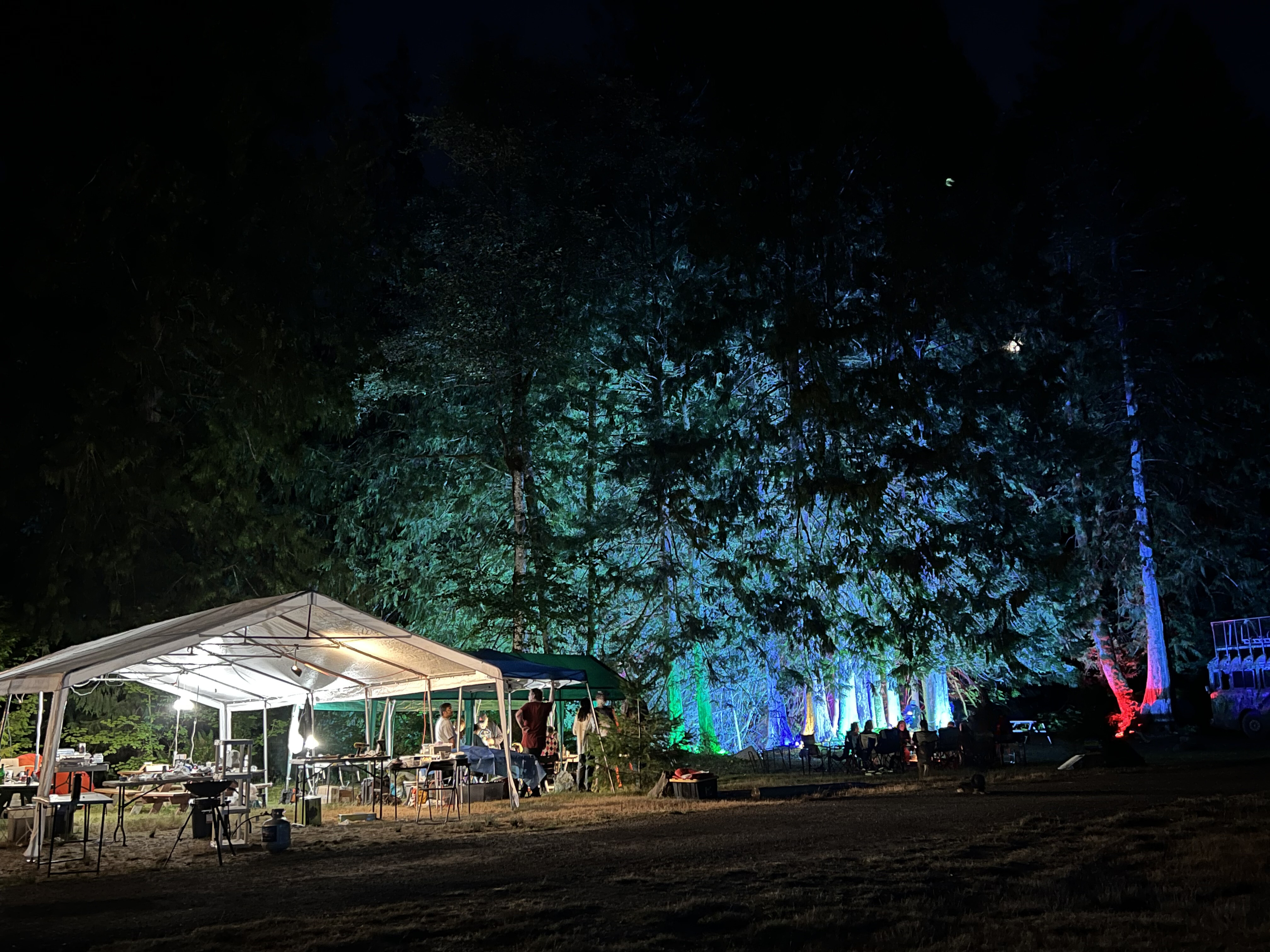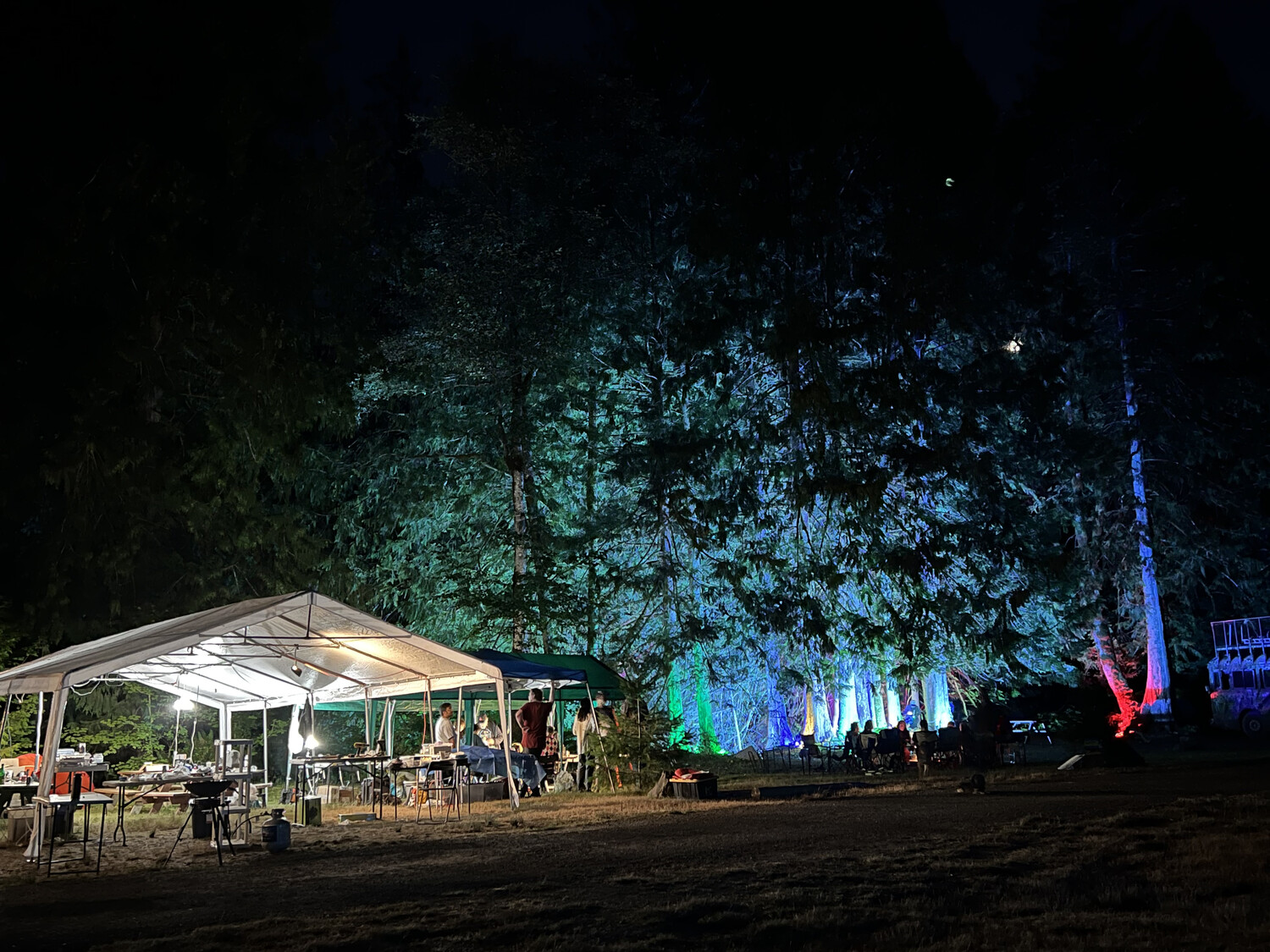
For more than a decade, a small town in the foothills of the Cascades has quietly hosted one of the Pacific Northwest’s most unusual creative laboratories. At Electric SKY—a camping-based art-and-technology retreat in Skykomish, Washington—artists, coders, designers, and curious tinkerers pitch tents, set up a pop-up lab deep in the trees, and spend a long weekend testing ideas that don’t fit neatly anywhere else. Projects sometimes begin as half-formed thoughts or weird sketches. By Saturday night, they emerge as installations glowing in the forest.
This March, that mountain energy comes to downtown Seattle. Electric SEA, a new art-and-tech creative hackathon and public exhibition, extends the Electric SKY model into the city for the first time. It’s a shift that feels both natural and urgent, as the region’s flourishing but fragmented creative-tech community looks for places to gather again.
The hackathons are a “really good incubator for really novel, innovative work,” says Shelly Farnham, an artist, technologist, founder of Third Place Technologies, and one of Electric SEA’s organizers. “People come in with half-finished ideas or things they want to try out, and we create a lab where those projects—and those collaborations—can actually happen.”
Electric SEA, hosted by Third Place Technologies in partnership with PublicDisplay.ART and Src Material runs March 26–28 across two downtown spaces. PD.A’s offices will become a maker lab, while the ArtLove Salon upstairs will host workshops, breakout sessions, and the culminating exhibition.
Electric SKY grew out of a 2014 workshop that Farnham organized at Cornish College of the Arts on fostering art-tech collaboration in the Pacific Northwest. The resulting paper helped shape the early vision for Third Place Technologies, her nonprofit dedicated to building interdisciplinary creative communities. “One of our issues has been: How do you translate between artists and technologists? They don’t always speak the same language, and they don’t always collaborate the same way,” she says. When early artist participants balked at the term hackathon, the organizers renamed it a “creative retreat.” “But it’s basically a hackathon,” Farnham adds.
Whatever the name, the model worked. Electric SKY became an incubator for interdisciplinary work—laser-cut sculptures, microcontroller-driven installations, light-based landscapes, and occasional experiments powered directly by the Skykomish River. One year, artists placed artificial resin rocks embedded with tiny turbines into the rushing water, and the current lit up embedded LEDs. Another year, someone built a turbine large enough to animate an entire display.
Skykomish’s own constraints—frequent power outages, recent flooding, a single road in and out—made renewable energy an ongoing theme. Workshops on solar, wind, and small-scale hydro became central to the retreat and have inspired plans for a permanent, renewable energy-powered art walk in town.
But the mountain location also limits participation. “We learned that this was a really good model for intensive collaboration and interdisciplinary innovation work,” Farnham says. “But a lot of people can’t come to the mountains. So for a long time, we’ve been thinking we would really like to do this in Seattle.”
Seattle has long been home to experimental work at the intersection of art, design, and technology—but the community remains scattered, especially since the pandemic began. New groups like Seattle Creative Coders have sprung up, while others have gone quiet or moved online. Labs appear in bursts at places like Passable, a Capitol Hill makerspace that Farnham also helps run, but large, flexible spaces that can handle art-and-tech needs are scarce in Seattle.
Electric SEA aims to be one such place.
Partly, it’s a civic gesture. Seattle is a city where public life and technological innovation are tightly intertwined. Hosting a hackathon downtown, near transit, and in partnership with a public-facing arts publication reframes the model as a civic event rather than a retreat. Farnham’s own projects—such as a glowing light art installation that visualizes data on community well-being in Seattle neighborhoods—reflect her belief that art and technology can come together to serve civic good.
The hackathon is also about fostering a sense of belonging, Farnham says. Many interdisciplinary practitioners, she notes, feel like “a little bit of an odd animal”—not quite traditional artists, not quite standard technologists. That in-between space can be isolating.
“When you have a community of people like that, and you have a sense of belonging, it helps to validate people in what they’re doing,” she says. Creating a truly welcoming environment is key to innovation. “As a community organizer, for me, a big part of it is creating a very welcoming environment where people feel comfortable, no matter their background or discipline. And because of that, they’re more willing to take risks.”
Electric SEA will host eight workshops—some invited, some from open calls—covering creative coding, soldering, fabrication, data visualization, physical computing, and more. Workshop stipends will support instructors, while project microgrants (up to $500) will help participants who are pursuing more elaborate builds, particularly those involving motors, sensors, microcontrollers, or multi-part fabrication.
Most creative coders can self-fund, Farnham notes. It’s the physical computing projects that more often need assistance. Workshops have always been collaboration seedbeds at Electric SKY, and they’ll play the same role in Seattle, encouraging experimentation, skill-sharing, and cross-pollination.
Artificial intelligence is likely to be a major theme at Electric SEA, though Farnham is mindful of its controversy within the arts community. Some practitioners worry (rightly, she says) about ethics, labor, authorship, and the blurred lines between assistance and automation.
“Through events like this,” Farnham says, “you can have those conversations around: Here are these cool tools that are AI, and they're awesome. But how do we use AI in an ethical way that is responsible to the concerns of the creative community?”
That question folds into the broader goal of building best practices for interdisciplinary work. Electric SEA is not just about what gets built but also how people collaborate, share knowledge, and form teams that continue well beyond the weekend.
For the first time, Electric SEA includes a juried prize sponsored by Src Material, a Seattle-based creative technology nonprofit. The prize is less about competition than visibility—a way to acknowledge the rigor and ambition required for hybrid work.
Farnham measures success differently. “If a year later, I see two people collaborating who met at an event that we hosted, I feel really excited. And it's like some people [who] would never normally meet, like a more traditional artist or designer with a really technical, creative coder. And now they're collaborating.” In other words, success for Farnham is an emergent community and a set of relationships strong enough to sustain risk-taking. It’s a shared belief that this interdisciplinary ecosystem is not an outlier but a field with a future.
Electric SEA is free to attend, thanks to support from 4Culture, ArtsFund, ArtLove Salon, the Conru Arts Foundation, Passable, and other orgs. Anyone curious about interdisciplinary collaboration is welcome, Farnham emphasizes, and anyone can come to the Saturday-night party and exhibition, whether they built something or not.
For a city grappling with rapid technological change, frayed social ties, and ongoing debates about public space, Electric SEA offers something modest but powerful: a place to gather, experiment, learn from one another, and imagine what Seattle’s creative future can be.