Materialist Manifesto
What artistic practice can teach us about healing the planet
Materialist Manifesto
What artistic practice can teach us about healing the planet
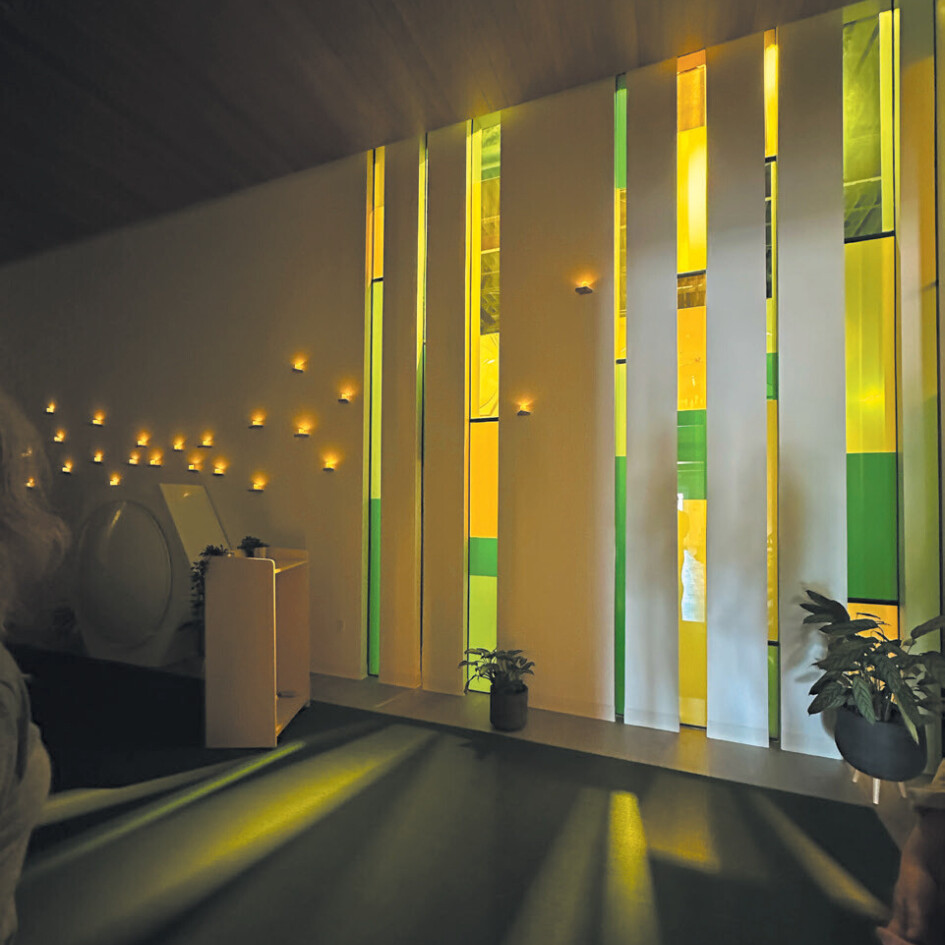
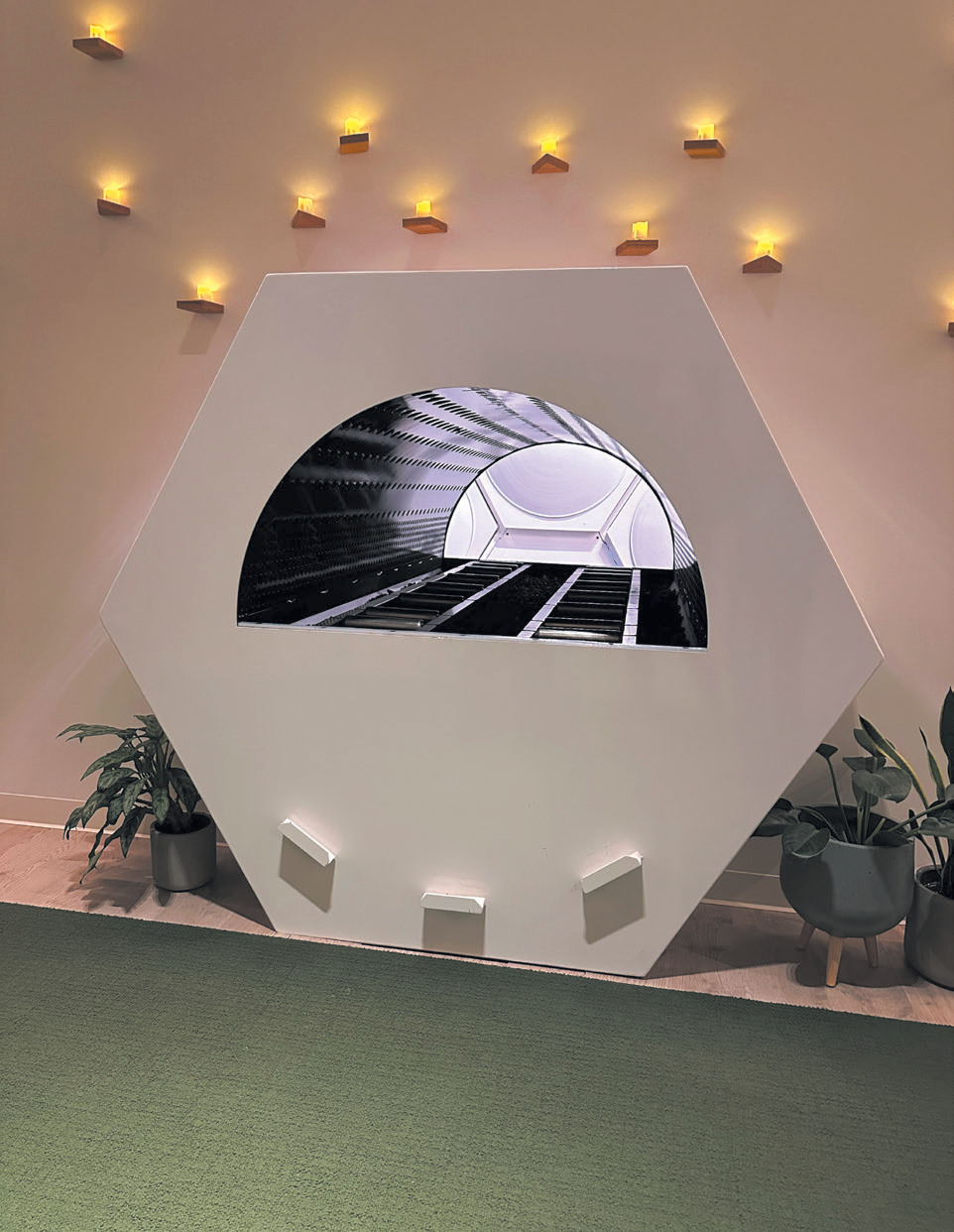
Let me tell you what happens when a body gets composted. They roll you out on a cart, your body swaddled in a linen shroud, a bouquet draped over you. You’ve been wheeled into a small chamber dappled with light—warm emerald and honey-colored—that filters through stained glass. On the other side of the glass is a much larger room. It’s more industrial and futuristic, but a quietude still hangs in the air in hushed respect for the dead, some thirty-four of whom are resting, suspended in a honeycomb grid of white cylindrical stainless steel vessels.
Back on the other side, in a chapel that feels equal parts earthy PNW and sci-fi, you are ushered toward a large hexagonal portal that bridges the two rooms. After loved ones have uttered their last words and performed their rites, your body passes through the threshold to begin the natural process of decomposition and afterlife as soil.
All of this is happening right here in Seattle at a place called Recompose. Natural organic reduction, aka human composting, is an alternative to burial and cremation that returns human remains to the earth through a process that uses 1/8 the energy of the other conventional methods. It’s rapidly gaining popularity in the US. It is currently legal in twelve states and pending in many more. As uncanny as it may sound to some, the decomposition process itself is surprisingly rapid and, well, natural: it only takes eight to twelve weeks for the body to break down, thanks to the host of microbes that live inside us all our lives (curious invisible passengers). After that period has passed, loved ones can return to retrieve all or some of the soil made of you. There’s actually quite a lot—around one cubic yard.
What does this have to do with art? A lot, I think. It has to do with rethinking our relationship to the material world and our place within it.
Since the mid-20th century, many artists have made a practice of examining the “everyday.” As mass culture barreled toward increasingly industrialized, globalized, mindless consumer behavior in the latter part of the century, it became the mission of some movements to examine the banal, intimate aspects of daily human grind. Movements like Fluxus and the Situationist International came to prominence in the ‘60s and ‘70s as vehicles for critique of capitalism. Artists like Yoko Ono staged performances that forced participants to slow down, look closer, or approach situations—both physically and intellectually—from new and often jarring perspectives. For some, the examination of the everyday was political and social; for others, spiritual, or something in between.
Few, if any, artists back then could have imagined the extent to which our current condition has become removed from the “realness” of the everyday. The existential gulf facing us is not merely spiritual or social, but borders on absolute detachment from the material world. This kind of detachment is a death sentence, as evidenced by the havoc wrought on our planet. If we are to survive, we have to rekindle an appreciation of the everyday, material world. We have to start falling in love with our trash.
Let’s return to Recompose for a moment. The facility—a warehouse transformed by Olson Kundig on the interior with a vibrant mural of foliage and fungi by Jeff Jacobson on the facade—is located in an industrial strip in SODO, nestled amid an array of more warehouses, old Boeing hangers, and shipping containers stacked along the Duwamish River. Directly across the street from it is Recology’s Material Recovery Facility. Recology is one of the recycling companies contracted with the City of Seattle to process your waste. This facility (MRF for short, pronounced like “merf”) is where blue bin material goes to get sorted. I’m very familiar with this place because Recology hosts an artist residency each year. It’s unlike any other residency you’ll come across: for four months, artists are given full access to the site to scavenge any of the materials passing through—some 300 tons a day.
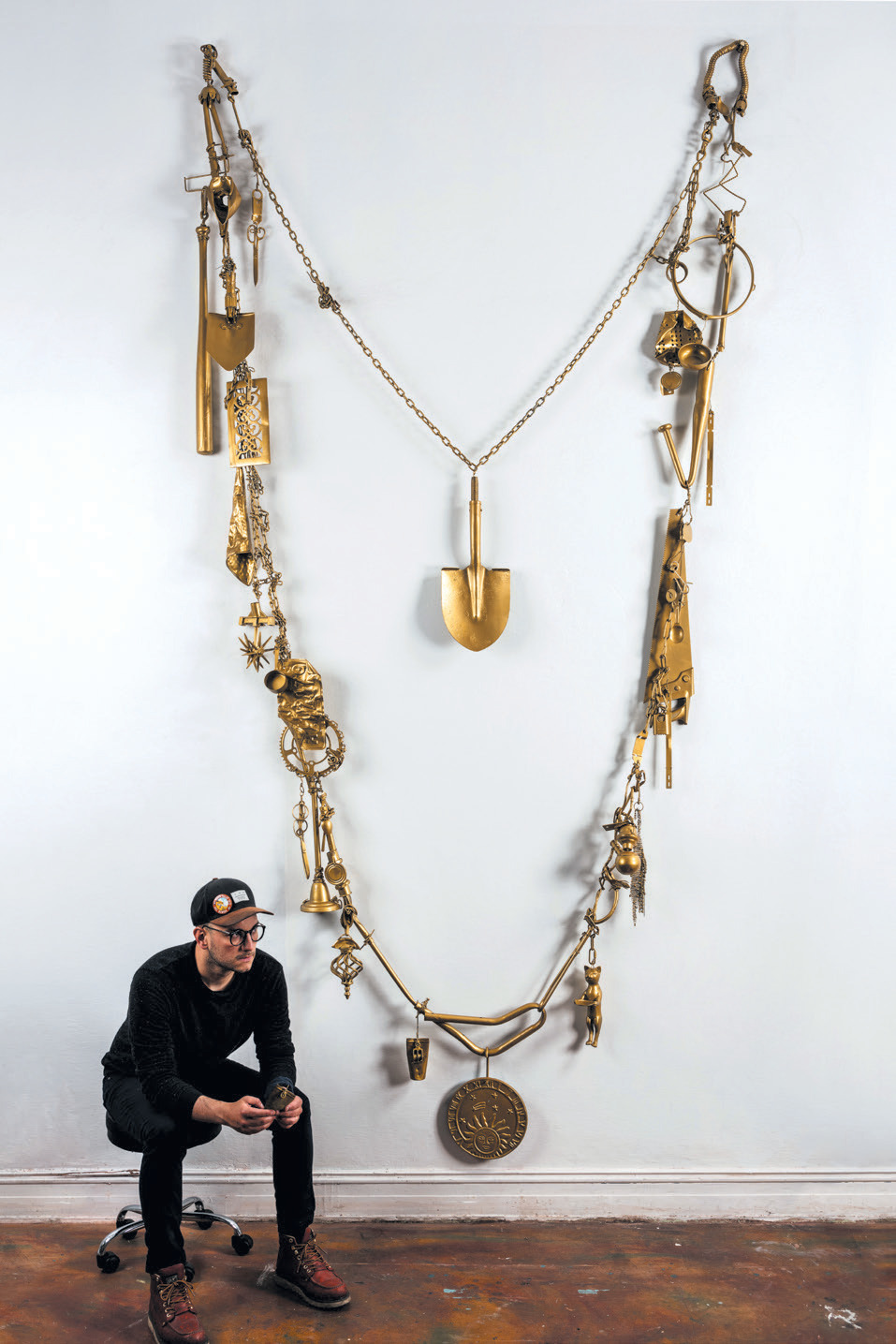
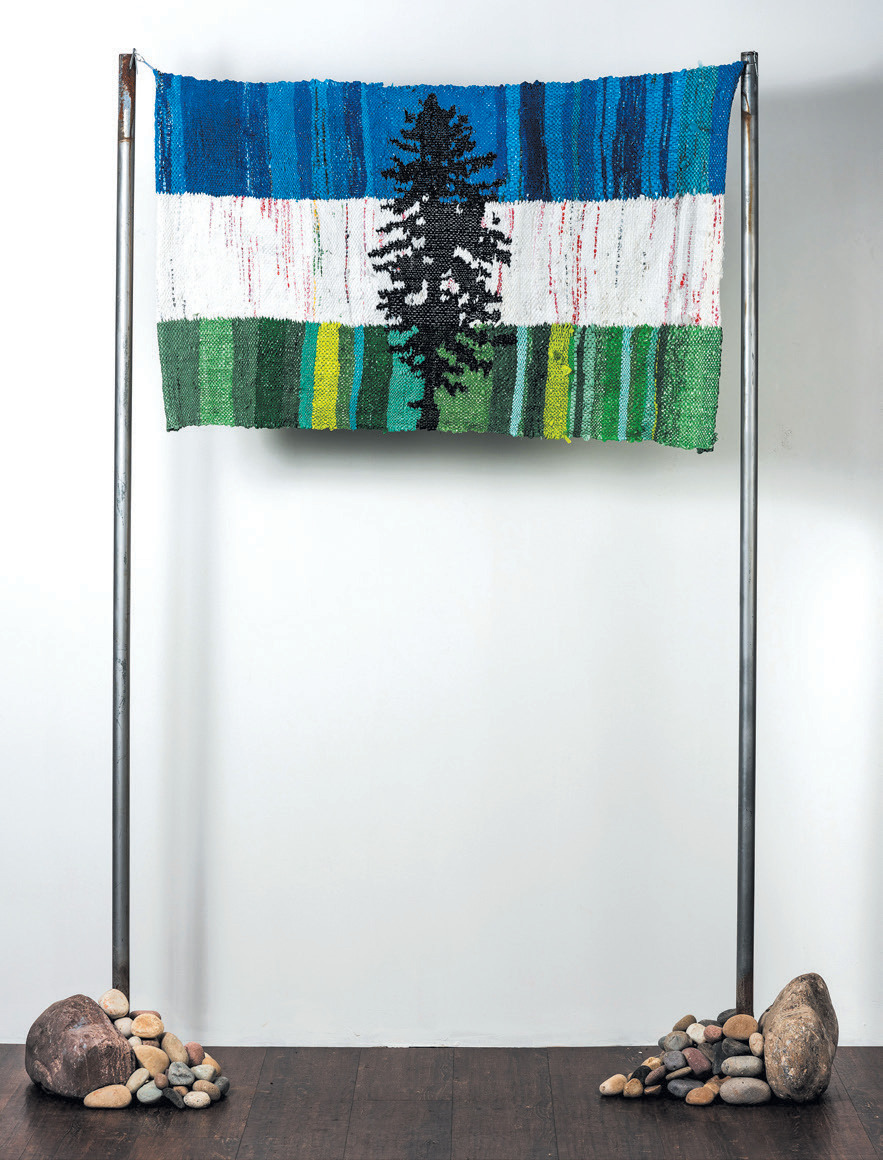
Over the past nine years, artists have produced the miraculous out of “filth.” Susan Robb collected plastic bags (before the ban) and wove intricate tapestries from their shredded strips, incorporating graphic designs like the mythic Cascadia flag. Hernan Paganini plumbed the metal dumpsters, retrieving a wunderkammer worth of industrial and household discards, from tools to pots and pans and trinkets, which he pieced together in monumental assemblages that resembled oversized charm bracelets. Others have worked with the colorful rubber soles of shoes, wax-coated paper coffee cups, unraveled marine ropes, and cardboard boxes.
I was one of the artists last year, and the experience brought me to my knees. There’s nothing more grounding— no meditation, gratitude, or sun salutation—than being surrounded by 300 tons of trash. The reality of material really sinks in.
It’s difficult to visualize 300 tons, even when you’re there. It’s a mass in continual motion, continually being pushed around. Trucks coming and coming, day in and day out, spilling their loads onto a conveyor belt where human beings and machines work together to sort out contaminates like pineapples, potatoes, garden hoses, shoes, photo albums, rubber balls, pots and pans, mannequins. You name it, it’s been thrown into the recycling and it’s come along the belt. All the garbage and “wish-cycled” stuff must be weeded out before the rest can be bundled into bales to be sold and processed.
Most people will never witness this part of our current material reality, let alone think of it daily. Or they’ll spend time bickering about the shortcomings of an admittedly inefficient (if still fairly effective) recycling process. Both camps miss the bigger picture of our material culture—we don’t see material in the first place, yet we’re drowning in a material cesspool of our own making.
Let’s make no mistake: in the long run the planet will fare just fine. Life will carry on splendidly, on its own terms, the way life always does. Life proliferated during seasons of acid rains, molten seas, and asteroid impacts, and it will continue to do so no matter how much we send the planet into a catastrophic tailspin. The one thing we’ve surely succeeded in destroying is the balance and homeostasis we came up in, the comforts and oasis we have known.
I should clarify: the comforts that white, middle-class kids like me grew up with. Let’s be clear on this too: the homeostasis and oasis we have known are such for only a select chunk of society. When we talk of golden ages and normalcy, we’re talking about systems of ease created for a few, made possible by the subjugation of many. It’s a nasty human tendency.
So, where do we go from here? How do we not move backward to where we were (impossible anyway), but forward, through this present plastic-choked morass in which we find ourselves, toward something sustainable?
I think we start by becoming lovers of everyday materiality in a very material world. Western ideology doesn’t hold much space for the practice of animism, let alone regarding inorganic material as vibrant or in some way alive with its own agency. And yet: ashes to ashes, dust to dust, plastic to plastic—we’re all made of the same material, composed of the same stardust. If we are to love our neighbor as ourselves, might we not also consider loving material as ourselves?
One of Yoko Ono’s pieces in Grapefruit, the 1962 “Mend Painting,” contains the following instructions: Pick an old scarred painting. Wash it thoroughly with soap. Powder it. (This process may be eliminated according to your taste.) Perfume it. The perfume may be a cheap one or an expensive one, depending on your taste. The time should be in the evening before the lights are lit. You should go near the window and do it if it becomes too dark. You may use an old wall, pavement, shoes, gloves instead of a painting.
In the same way Mary Magdalene washed and perfumed the feet of Jesus, Ono instructs us to anoint the discarded and scarred. This is the new art. There is a term I’ve been using called “radical kintsugi.” The word kintsugi, Japanese for “golden joinery” or “golden repair,” refers to the art of mending broken pottery and accentuating the seams with lustrous gold lacquer. Rather than hide the imperfection and the mending process, the broken cracks shimmer.
By radical kintsugi I mean a practice of restoration rooted in a reverence for the material world. It’s the “reuse” part of the three R’s—Reduce, Reuse, Recycle—but taken to the extreme. A way of life.
This is not a call to become hoarders or Luddites, but an exhortation to be present with material. In quotidian terms, it’s an appeal to stop dissociating at the grocery store (stop buying so much stuff in the first place). Before you purchase a plastic container of something, think twice about the terrifying immortality of the object in front of you. After all, a plastic bottle is far more eternal than you, my friend. You, who take mere weeks to return to dust.
Going forward, we must engender a new respect for this particular creation of ours, plastic. As of 2020, we had created approximately 11 billion metric tons of this immortal plastic, an amount that surpasses the biomass—the flesh and bones and fins and blood—of all animal life forms on Earth.
(For the love of everything, the next time you reach for a soda at the store, buy aluminum. Where plastic is a recycling nightmare, aluminum is a recycling dream, averaging a two-month turnaround from blue bin to back on the shelf, with zero material loss in the process.)
Abuse of plastic is abuse of power. Plastics are a humanitarian issue. Plastic is absolutely intertwined with oppression, colonization, all of these wars spiraling out across our present and into our future. We must unlearn plastic to relearn plastic. Plastic is holy in a truly frightening way. We must treat such material with reverence.
If I’m sounding delulu, so be it. It will take a little delusional energy to reset ourselves and right this ship.
And we can. We accomplish this by way of small things— small actions and small practices that amass to powerful movements over time. We do this through some very large actions too: the deliberate re-learning and re-telling of new narratives. Like embracing the fact that our bodies are temporary variations of a material composition as brilliant and banal as soil. We must become like those artists who examine the everyday and unearth the buried pleasures and ecstasies of the ordinary. We must be the new poets who shrug off the old stories that got us tangled in this late Capitalist quagmire. We must not only acknowledge, but live the interconnectivity of matter as if our lives depended on it.
It’s not mere hyperbole. Microplastics course through our veins and fill our lungs, invisible passengers alongside the microbiome.
Our survival depends on cultivating a practice of the everyday. A practice of slowing down and seeking magic. A practice that takes part in the labor of material mending and anointing the broken things. We don’t need to learn to steal like an artist; we must learn to heal like an artist. This is a place to start. Or to quote Yoko Ono, “art is a way of survival.”
Gleanings, featuring Recology King County artists in residence Margie Livingston and Kalina Winska, will be on display at 6118 12th Ave S, Seattle, through Sep 14.
