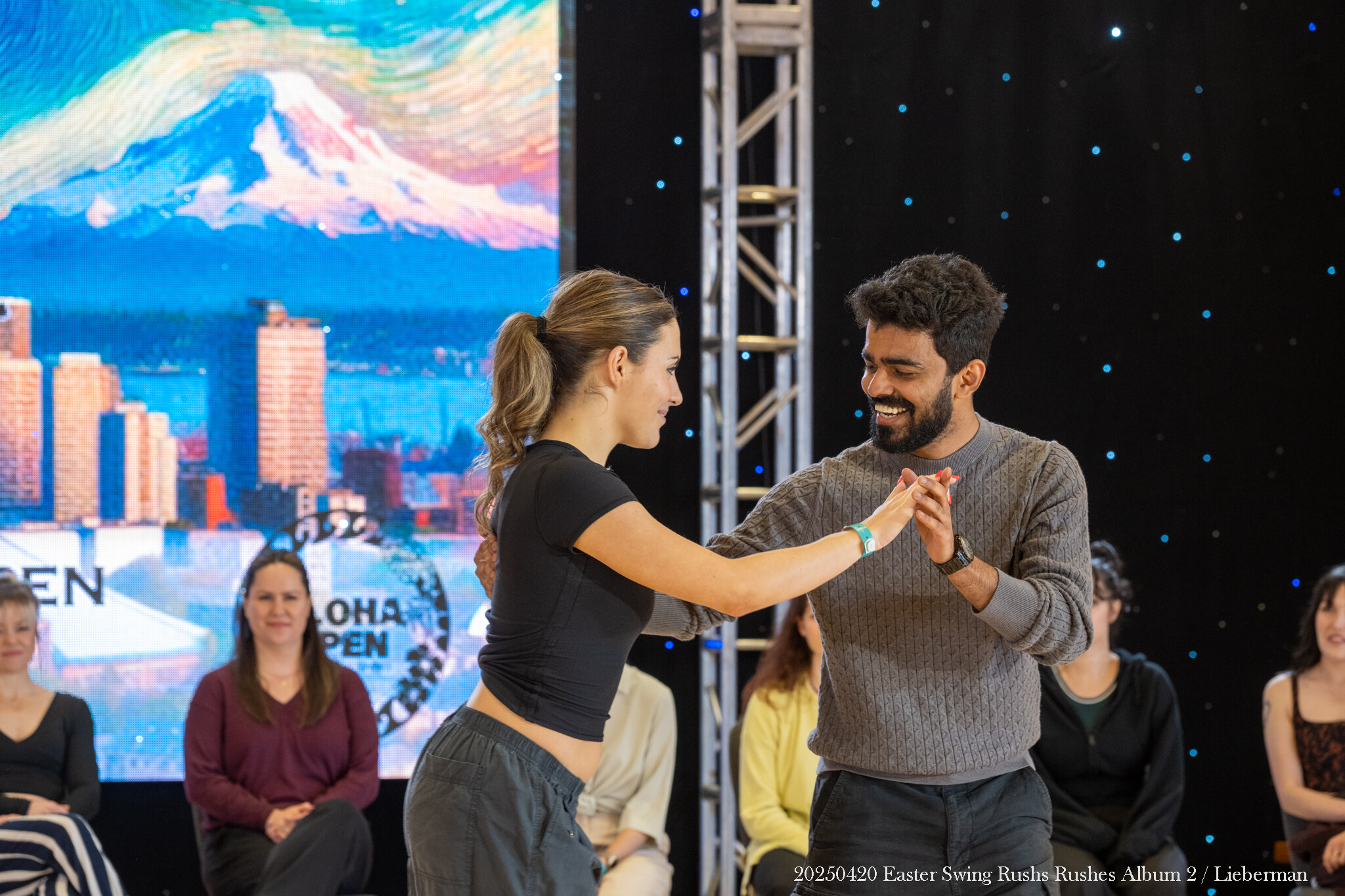
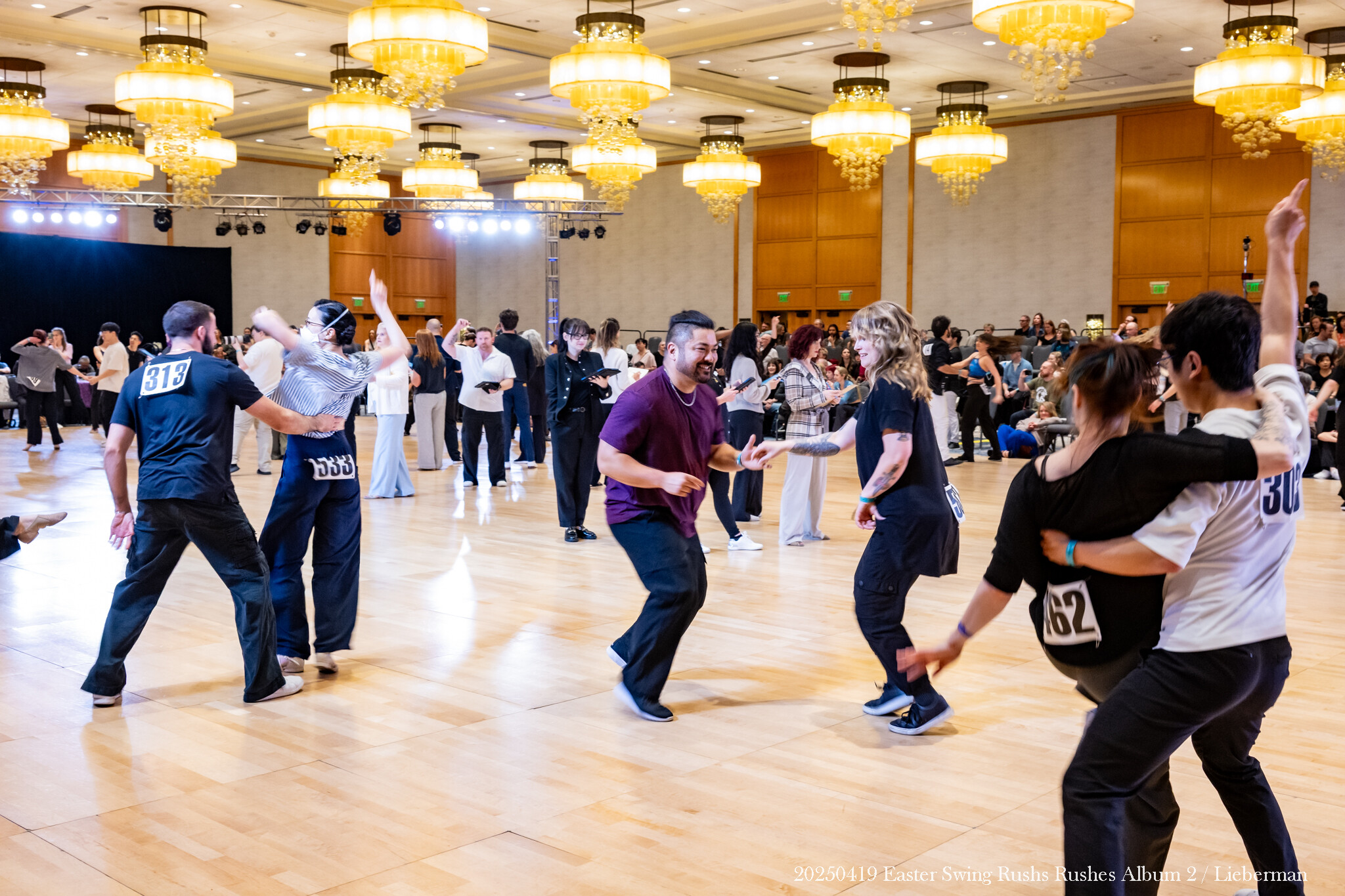
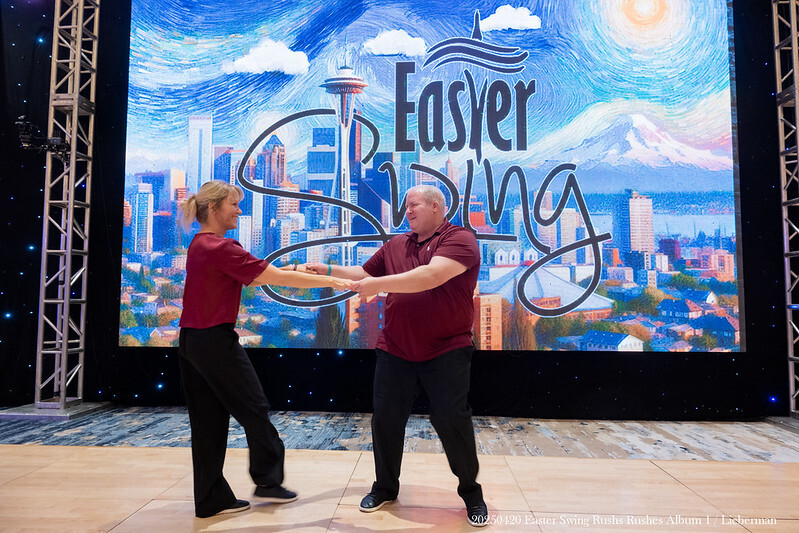
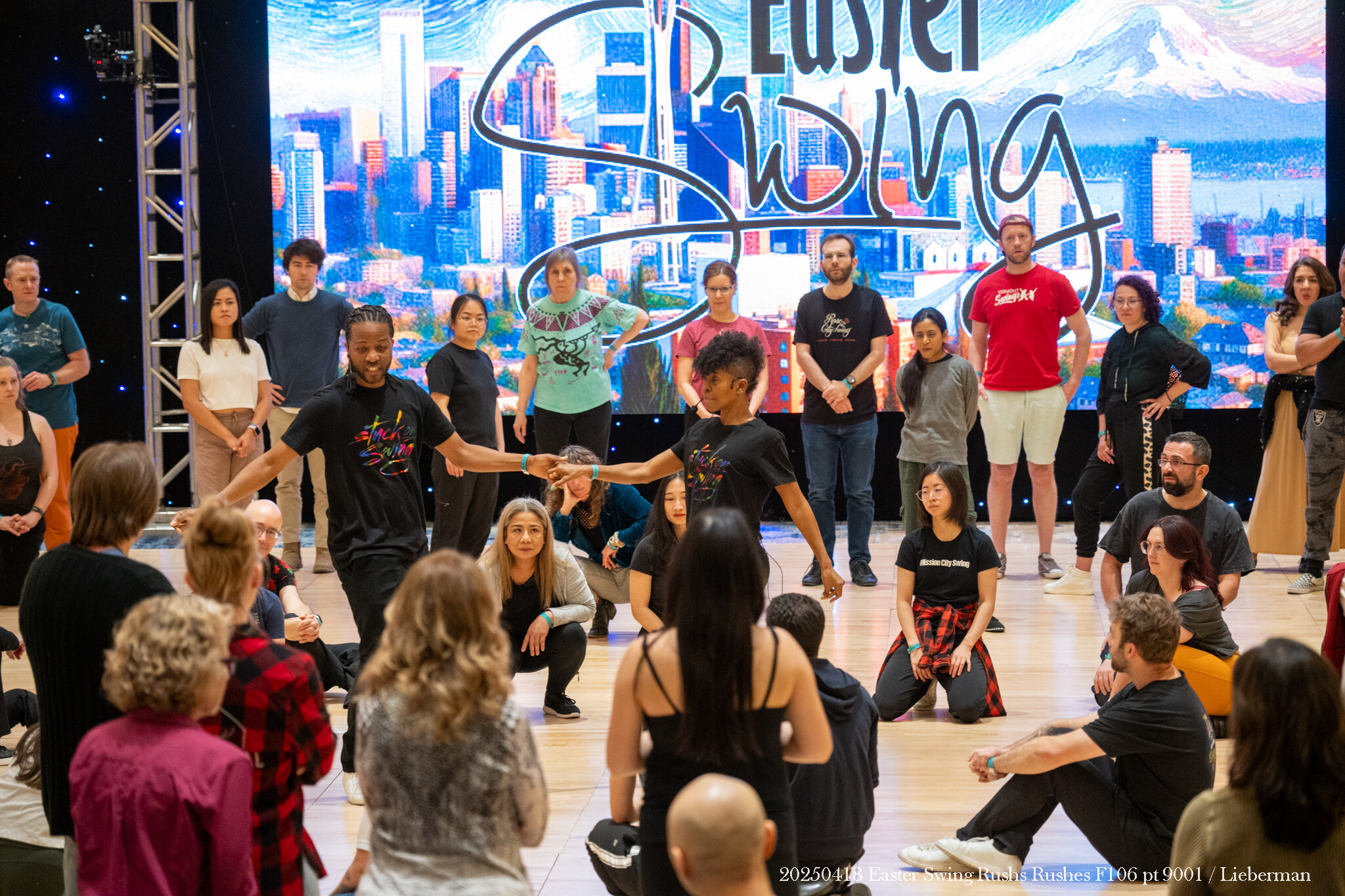
Easter Swing 2025 Sunday Rushes. Photos by Josh Lieberman.
The hottest party in Seattle?
It’s not the nightclubs. In fact, it might be quite the opposite: West Coast swing dancing. But this isn’t your stuffy ballroom, white dress cotillion-esque scene. It’s smooth and sexy—imagine Blurred Lines come to life—and it’s taking over the social media world.
West Coast Swing was born in California in the 1940s as a smoother alternative to the traditional Lindy Hop. What started as a regional dance eventually earned the title of California’s state dance in 1980.
Today, West Coast Swing is taking the world by storm for a second time amongst newer generations, in large part thanks to social media. The real kicker with West Coast Swing was its popularity on YouTube. Top-level performers like Ben Schwummer, who won So You Think You Can Dance in 2006, brought viewers flocking to the sport, and to his channel.
Prominent figures like Jordan Frisbee and Tatiana Mollmann, renowned for their innovative choreography and extensive teaching tours, have leveraged platforms like TikTok to share their routines, inspiring a new generation of dancers.
Since then, the expansion of West Coast Swing has known no bounds. The choreography of Frisbee and Mollmann has inspired dancers worldwide to embrace the style, many adding their own variations, introducing elements from their respective cultures.
Dancers like Emeline Rochefeuille and Jakub Jakoubek have captivated audiences with their synchronized performances, showcasing the versatility of West Coast Swing to meld with contemporary music trends, like Ed Sheeran and Beyoncé. Dancers like Slavik Pustovoytov and Aubrey Fisher have gained substantial followings by blending West Coast Swing with modern dance elements. These styles are showcased at conventions, which occur a couple times per year across the US. A few notable names are The Open in California, Liberty Swing in New Jersey, Lindy on the Rocks in Denver, and Austin Swing Dance. Championships bring together dancers for vibrant weekends of workshops, competitions, and social dancing.
For some, it leads to a nomadic life, living out of a suitcase as they bounce from convention to convention. These conventions, put on by the World Swing Dance Council (WSDC), take place across the globe and are, in many ways, the lifeblood of this thriving community and world that is governed by the laws of the WSDC. Working one’s way up the ranks is a clearly defined path: There are certain divisions to these events, From Newcomer and Novice, to Intermediate, Advanced, and All-Star. To make it to champion level, one must earn points throughout a system of social dancing. To move up the ladder, performers compete in Jack and Jill competitions—random pairings in which participants are judged according to their skill level.
Despite such divisions, West Coast Swing is one of the most accessible and easiest to learn of the swing varieties.
“There’s a flexibility with the dance that doesn’t exist for other types of swings,” says Lan VoBa, a teacher at Fremont’s Salsa Con Todo dance studio. “And with the basic pattern of 2-3-3, it’s easy to learn.”
As a result, the dance itself is incredibly inclusive. And unlike the typical dances of Swing, West Coast can be done to any type of song.
“One time, I West Coast swang to a Gregorian chant…it’s possible. As long as there’s an up count and a down count, it’s literally all possible.” said VoBa. (Check out a typical West Coast playlist here.)
Photo by Josh Lieberman
Last weekend saw one of the largest WCS dancing events come to life in Seattle: Easter Swing, hosted each year by the Seattle Swing Dance Club. Founded in 1965, the SSDC is the longest running West Coast Swing dance club in the world. (Outside of the annual Easter Swing, they host recurring West Coast Swing events every first and third Sunday in West Seattle.)
It was a one-of-a-kind weekend at the Hyatt Regency Bellevue where this convention was held. Both newbies and long-time champions of the West Coast Swing world were in attendance. One event, the Beginner Boot Camp, saw over 400 new dancers joining in on the fun.
“This might as well be the West Coast Olympics,” said one attendee.
Dancers from all parts of the world flocked to Seattle for the event—from hubs of West Coast Swing like San Francisco, L.A., and British Columbia, to locations as far as Romania and South Africa.
“I’ve danced with people from all over the world,” said Olga, a 60-year-old woman from Russia. Olga’s been dancing since she was 5 months old: West Coast Swing gave her the wings to be a globetrotter.
Photo by Josh Lieberman
While some attendees found West Coast Swing through social media, for others it was by sheer chance. In a town of 2000 people, Jake from Vermont says he found his entire community through the dance.
“I saw an ad in the newspaper. I didn’t know anyone in my town,” he said. “Suddenly I had entered a new world, the world of swing.” Since then, he’s traveled across the country with his community.
For some, the dance has means newfound freedom and creativity that knows no bounds.
“You get to be free!” said Sage Hueyi Citlalin. Sage is 12, and has autism. Apparently, her great-great-grandmother is really into swing, and her nanny thought it would be a good way for Sage to feel seen. And it worked!
West Coast Swing is an art form in itself: It’s pure self-expression. Yet a sense of fierce competition is woven throughout the community. Like many art forms, West Coast Swing’s popularity rose with social media, and can be riddled with some of the negative aspects of those communities—like a tendency for competitions to favor the conventionally attractive, or exclude certain demographics.
“It can be deceptively cold. I love my friends here, but I wouldn’t have come for the culture.” said an attendee, who wished to remain anonymous.
A hierarchy exists even among the community of dancers at Easter Swing, they commented.
Yet, even with all of these potential qualms, the true beauty of West Coast Swing lies in the connections that it creates, even if those connections aren’t your typical kind. In fact, sometimes your partner won’t even want to chat. The only talking will be the exchange of body language, the push and pull of the dance.
Photo by Josh Lieberman
It’s a language that knows no limits, two minutes of truly just being present with someone. Of listening to your own innate rhythm, and intuiting the rhythm of your partner—even if that partner is a stranger. Being able to share that with another person is pretty wonderful.
“I enjoy the opportunity to connect with someone in a physical and emotional way. That doesn’t exist outside of the dance,” says VoBa.
In today’s times, it can be hard to find any place to exist as you are, free of barriers. We must do our duty to honor our human connection by preserving and practicing dances like West Coast swing. Regardless of how you’ve arrived to the art form, West Coast Swing is for all. So stay, take a chance and give it a try. Maybe even whisper to the DJ your favorite song du jour; odds are, they’ll likely give it a spin. You might find yourself swinging the night away. ??
Nova Berger is an everyday awe enthusiast who views the world as a cabinet of curiosities and hopes to share all hidden nooks and crannies and glittering whimsies and wonders with the world.