Ekphrastic: Dujie Tahat
On Buster Simpson’s Town and Country Crier
 Dujie Tahat•February 10, 2025
Ekphrastic: Dujie Tahat
On Buster Simpson’s Town and Country Crier
Dujie Tahat•February 10, 2025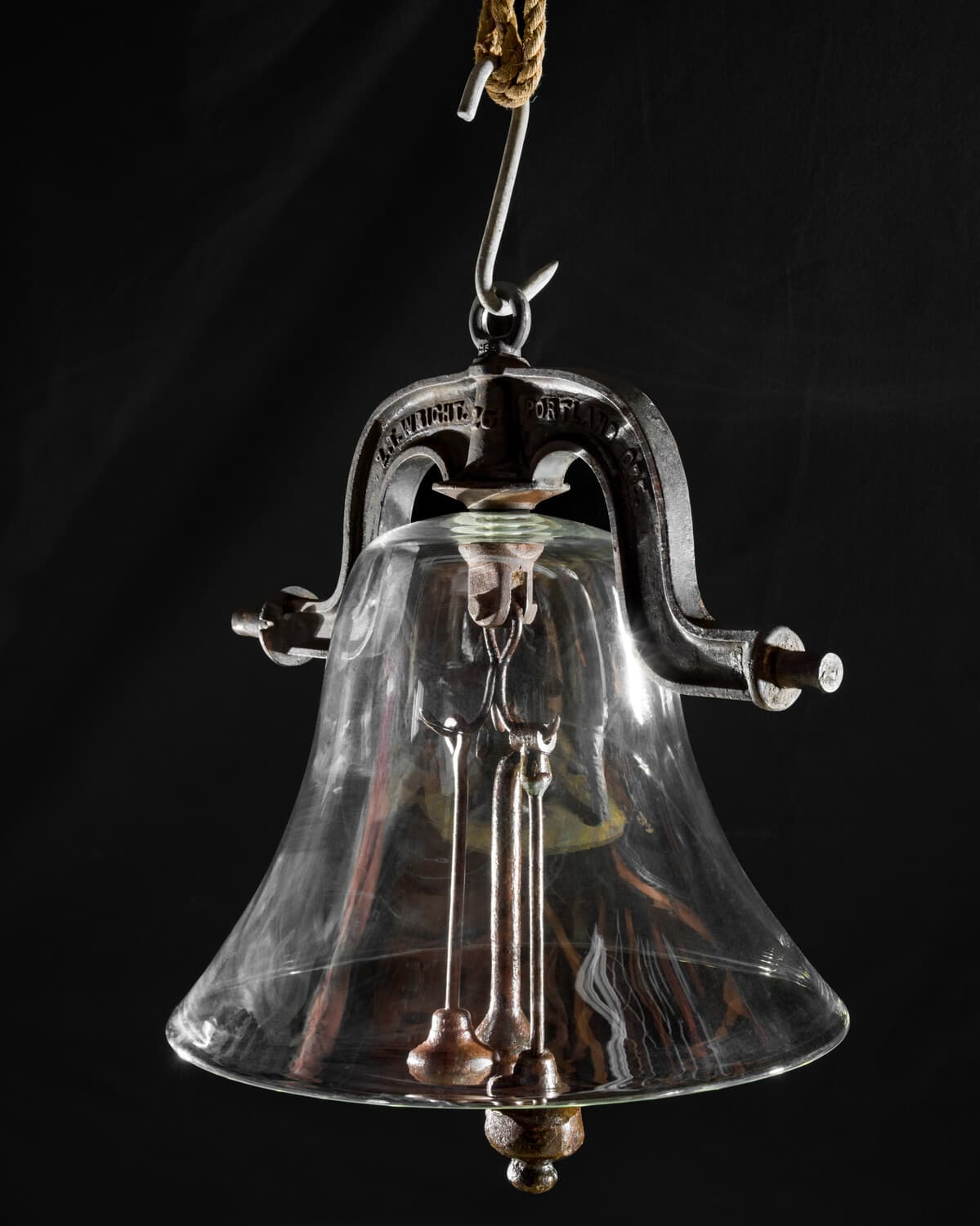
Yoke | The piece from which a bell is hung and swung.
Turns out January 31, 1950 was the city's coldest day on record. Seattleites woke up to zero degree temperatures and over 50 inches of snowfall. I tell my daughter what I found on my phone as I scrape her windshield for the third day in a row. It’s dawn. The kids have had breakfast, lunches packed, and we’re on our way to school. There are only 43 more days until she turns 16 and can do this on her own, she reminds me as we slide off of Beacon Hill.
Canon | Suspension loops that attach a bell to a yoke or other structural support.
William Nathaniel Bell is the namesake of Belltown. With Arthur and David Denny, he was one of the first settlers to claim land under the 1850 Donation Land Claim Act. What a phrase—both given and taken. It should not need to be said that, prior to Bell’s arrival, the Duwamish people lived here. Hundreds of Duwamish people lived in about 17 villages with more than 90 longhouses from the banks of the Bay to the River and around the Lake. Bell got a neighborhood, Denny got a street, and their children were set for life. The Duwamish people had a sophisticated social structure interwoven with surrounding land, seasons, and peoples. It needs to be said.
Crown | The top or head of a bell.
The president has floated the idea of a penal colony. Those repeat offenders, we hear him say on the drive to school, “get them the hell out of our country.” Separately but concurrently, he has empowered Immigration and Customs Enforcement to deport migrants living in the United States without papers. The day they arrested 1,200 people, ICE vehicles were spotted in neighborhoods around Belltown—Queen Anne, South Lake Union, and Downtown all the way to Chinatown–International District, Tukwila, Auburn, and Kent. Being in this country without documents is a civil offense, not a crime. It needs to be said.
Shoulder | The upper sides of a bell, often bearing inscriptions or designs.
Buster Simpson has spent 40 years thinking about Belltown. Since 1979, he’s installed tree guards made of bed frames and crutches up and down First Avenue. In 2003, he installed a painted aluminum cistern in the shape of an outstretched hand to collect roof watershed from the building at 81 Vine Street. A little further south, in 2015, he installed two chairs fashioned from ladders onto buoys facing each other near the mouth of the Duwamish River. Titled Discombobulated Discourse, one seems to be asking, “What are we saving?” While the other responds, “For whom?”
Waist | The middle sides of a bell.
When I was a kid, I’d trap grasshoppers in glass jars and walk away because I could. I lived on an apple orchard that my mother’s uncle married into. My parents picked fruit alongside other migrant farmworkers as a way to pay rent. I’d line up the glass jars—most filled with grasshoppers, some with stick bugs, and usually one with a frog. I called them my pets.
Sound Bow | The thick part of a bell against which the clapper strikes.
Glass is made from sand, limestone, soda ash, and sometimes recycled glass—heated until they melt and form a liquid, which is then shaped, in this instance, into a bell. I can see through it but can’t tell from the image if Simpson’s glass bell works. I mean “works” here in the functional labor sense: I want to see through how it makes sound, marks time, calls you in for lunch, ends a shift, signals a wildfire, mourns a stranger’s death, concludes another war.
Mouth | The open part of a bell.
The cold is bad, but the dryness is what’ll kill us. I’m alone in bed when I learn it’s the third driest January in Seattle’s history. The kids are asleep on the other side of town. I should call them, go to them, shake them from their sleep to let them know that the snowpack is, once again, unseasonably low. These abnormally dry conditions mean we are staring down the cold, barren road of another drought. I feel silly for panicking that they will have to survive a water war, but when I look it up, the United Nations has been ringing the alarm for years, warning against the lack of international cooperation that leaves 3 billion people without access to clean water, fueling the “imminent risk” of a global crisis.
Lip | The lowest edge of a bell.
The difference between a lip and the mouth is the difference between the line that makes the circle, and what we fill it with is the difference between what’s visible and where the sound comes from. It has to be said.
Clapper | A metal shaft terminating in a solid sphere that swings back and forth inside to strike a bell and make it ring.
The difference between ice and snow, I explain to my daughter, when it comes to driving, is traction. Traction is not unlike faith—to which she rolls her eyes, knowing well where I’m headed, given my tendency to lecture, obsessed as I am with words and meaning. Traction is like faith in its hold on what we don’t know or the extent to which an idea gains popularity or even, too, the forced posture required to heal a limb or muscle or spirit. While snow is still slippery, it comes down in separate pieces like sand or migrants or grains of rice. It offers a bit more grip. It has to be said. You can see through ice—I wave my hand on the other side of the windshield to demonstrate—but you have less control. Slow down. Remember that you can’t always see where it begins or ends or whether or not it’s all connected.
—
As an artist active since the late 1960s, Buster Simpson has worked on major infrastructure and planning projects, sight-specific sculptures, museum installations, and community interventions. He is a recipient of numerous awards, among them NEA Fellowships and the Americans for the Arts Public Art Network Award in 2009. Simpson has exhibited at The New Museum, MoMA PS1, Seattle Art Museum, Frye Art Museum, The Hirshhorn Museum, Capp Street Project, and Museum of Glass. Town and Country Crier is on view at Slip Gallery from Feb. 7–March 8.
Dujie Tahat is a poet and critic living and working in Washington state. They are the author of three poetry chapbooks: Here I Am O My God, selected for a Poetry Society of America Chapbook Fellowship; Salat, winner of the Tupelo Press Sunken Garden Chapbook Award and longlisted for the 2020 PEN/Voelcker Award for Poetry Collection; and Balikbayan, finalist for The New Michigan Press/DIAGRAM chapbook contest and the Center for Book Arts honoree. Along with Luther Hughes and Gabrielle Bates, they cohost The Poet Salon podcast.
Ekphrastic poetry is a literary device through which the writer responds to a visual work of art through use of vivid description, extending the experience of an artwork into the realm of language.