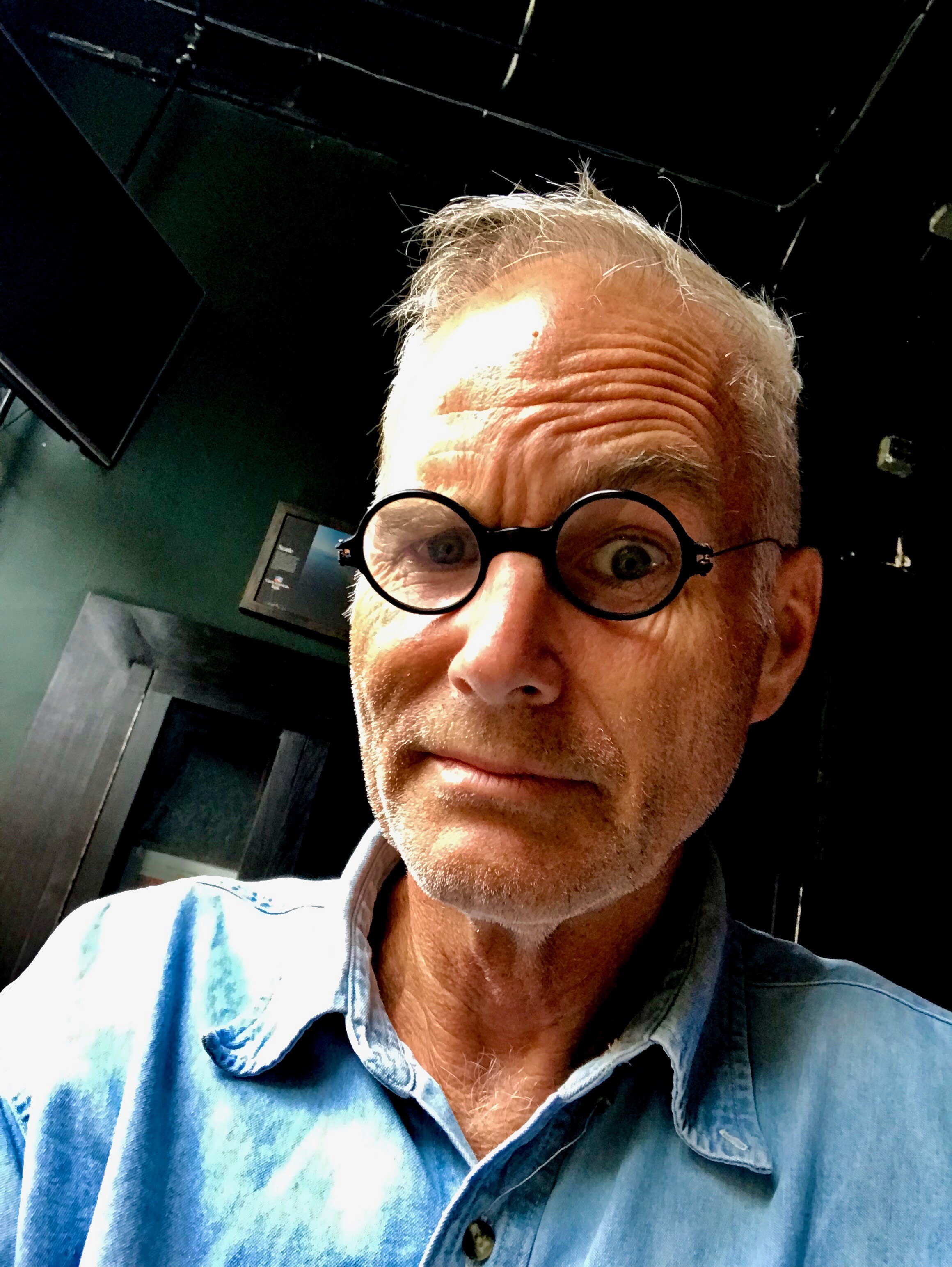
The Tantric Art of Collecting
A conversation with Joseph C. Roberts about supporting artists

The Tantric Art of Collecting
A conversation with Joseph C. Roberts about supporting artists
People collect art for many reasons. Joseph C. Roberts was raised in Yarrow Point, Washington, and descended from a family of antique dealers. A lover of literature and a patron of the arts, he has led the boards of both CoCA and Copper Canyon Press. With a globe-spanning career, Roberts now co-owns and operates the Royal Block, a boutique hotel in Waitsburg, which houses his art collection.
When visiting his home on Whidbey Island a few years ago, Roberts let me in on a secret: There exists a closet somewhere—actually several storage units—filled with artwork he’s bought over the years but never unpacked. This came as a shock, partly because he was referencing a drawing of mine that ended up in said storage. What he explained to me then has echoed in my mind ever since. I recently returned to probe him about his approach to art collecting.
AMANDA MANITACH: How did it begin, your journey to amassing art?
JOSEPH ROBERTS: I did not set out to collect art. But I was curious, and curiosity swelled to seduction. Yielding merely whetted my appetite for more. Eventually, collecting did become an intention. But it was not the goal; it was a strategy to advance my emerging mission to inspire the creation of new artwork. The point is to invest in artists, not in art.
AM: Let’s back up to your childhood. Growing up around antiques must have influenced how you appreciate objects?
JR: It did. I began looking at paintings made by dead guys. My grandmother was an antique dealer with a home full of beautiful things. When I visited her as a child, I would sit for hours, mesmerized by a single painting. Later, I went to museums on free Thursdays and wondered why various paintings were on those walls. Grandma had more interesting things, I thought. I enjoyed seeing them in intimate, unassuming environments in dialogue with personal effects.
AM: Traveling when you were young also played a role in all this. Another thing you’ve said is that traveling is possibly the most important thing a person/artist can do (note to self).
JR: Traveling led me to see artists as cultural journalists. They create and document aspects of the culture they live in. I support artists because I value culture. Buying art is a direct way of supporting artists and, so, culture.
Traveling also led me to value free expression and societies that have the self-confidence to allow, encourage, and support it. Their cultures are more honest, interesting, and healthy. I think exercising free expression is essential to retaining that freedom. I see artists as both champions of free expression and cultural vanguards, so I shifted my focus to younger, living artists. They’re still producing art. Dead guys aren’t, and I can rarely afford mid- and late-career artists’ work.
Younger artists’ work often costs less because their work is not yet widely exhibited or collected. It is not yet and may never become recognized as culturally important. Most artists begin with youthful passion, but urgencies of life intercede. They need to eat, so they stop making art.
AM: You’re describing me at the time you bought my first piece. It was one of the first works of art I ever sold in Seattle, at a group show at SOIL. I didn’t have a gallery, or collectors, really. I think it sold for $500. That purchase was so important. And look, I’m still making art!
JR: Buying younger artists’ work is adventuresome. No one knows who will pursue a lifelong art career, nor who will be crowned the next rising star. None of those represented in art history books began there. And many artists do good work that is never recognized.
If an artist is creating work that I think holds promise, I want to look at it with an open mind and deep curiosity. I want to engage and encourage her to discuss and defend her work. I’m happy to critique the work and the thought process that impels it. This engagement can lead to ongoing, if intermittent, conversations.
Years later, an artist may approach me, saying, “I’ve finally made something that really works, and I want you to see it.” I may say, “Great, I’ll buy it.” They respond, “No, wait! You haven’t even seen it.” “That’s unimportant,” I respond, “because I believe in you.” Elated, even if dumbfounded, they pack and send it.
AM: You did that to me once. I needed the money, but I wasn’t accustomed to that kind of transactional relationship. It felt one-directional, closer to patronage than collecting. It’s confusing, humbling, but also potentially life-changing. I’m still trying to make sense of it.
JR: Sometimes I store work without opening it, simply because I have no wall space and it takes time and materials to unwrap, re-wrap, and move the work. So, I own artworks I have never seen.
There is a tantric beauty in this dance. The artist created a work that, in her mind, is a breakthrough. She is elated, feeling I recognized the strength of her artistic spirit; this might be an inflection point in her career. Regardless, this may buoy her spirit and inspire her to continue making art. And, before the unveiling, the artwork may be everything I imagine it to be. So, why not keep the kimono tied? Tease that excitement and mystery for a while.
Not wanting to discourage artists, I try not to let them know that I don’t always open and display work. I hope the fact that I exchanged money for their work demonstrates that I value their work. More importantly, I hope it inspires them to continue their art-making practice.
AM: Right, it’s probably not in the best interest of an emerging artist to have all this laid bare. If you had not had a few other pieces of mine lovingly displayed in your home, it would have been more challenging information for me to digest.
JR: Of course, exhibiting and discussing an artist’s work can also inspire them to create new work. So, I do a lot of that, too—most recently at the Royal Block. I hope this helps others see and feel how living with art enriches spaces and the lives of those who inhabit or pass through them. Join us @theRoyalBlock. You be the judge.
Follow @theRoyalBlock for more information on Art Talks hosted by Roberts at the Royal Block in Waitsburg, Washington. Each month, a different work from Roberts's collection is highlighted and discussed in a salon setting, with the hope of expanding our understanding of art (and perhaps life). On March 1 Roberts will host Seattle artist (and Public Display editor), Amanda Manitach, for a discussion of a work of art that neither he nor she has seen since he acquired it in 2012. Join us for the unveiling!