Fan Art FTW!
Seattle is a haven for proud geeks, nerds, and cosplayers, yet comic and fan art remain on the fringes of respectability and even legality
Fan Art FTW!
Seattle is a haven for proud geeks, nerds, and cosplayers, yet comic and fan art remain on the fringes of respectability and even legality
Most people finish a movie, show, or book and move on. Other people finish a story and immediately start wondering what it would look like if they’d done it differently. An even smaller subset of those people answer that question by making fan art—their own takes on characters and worlds they didn’t create but can’t quite put down.
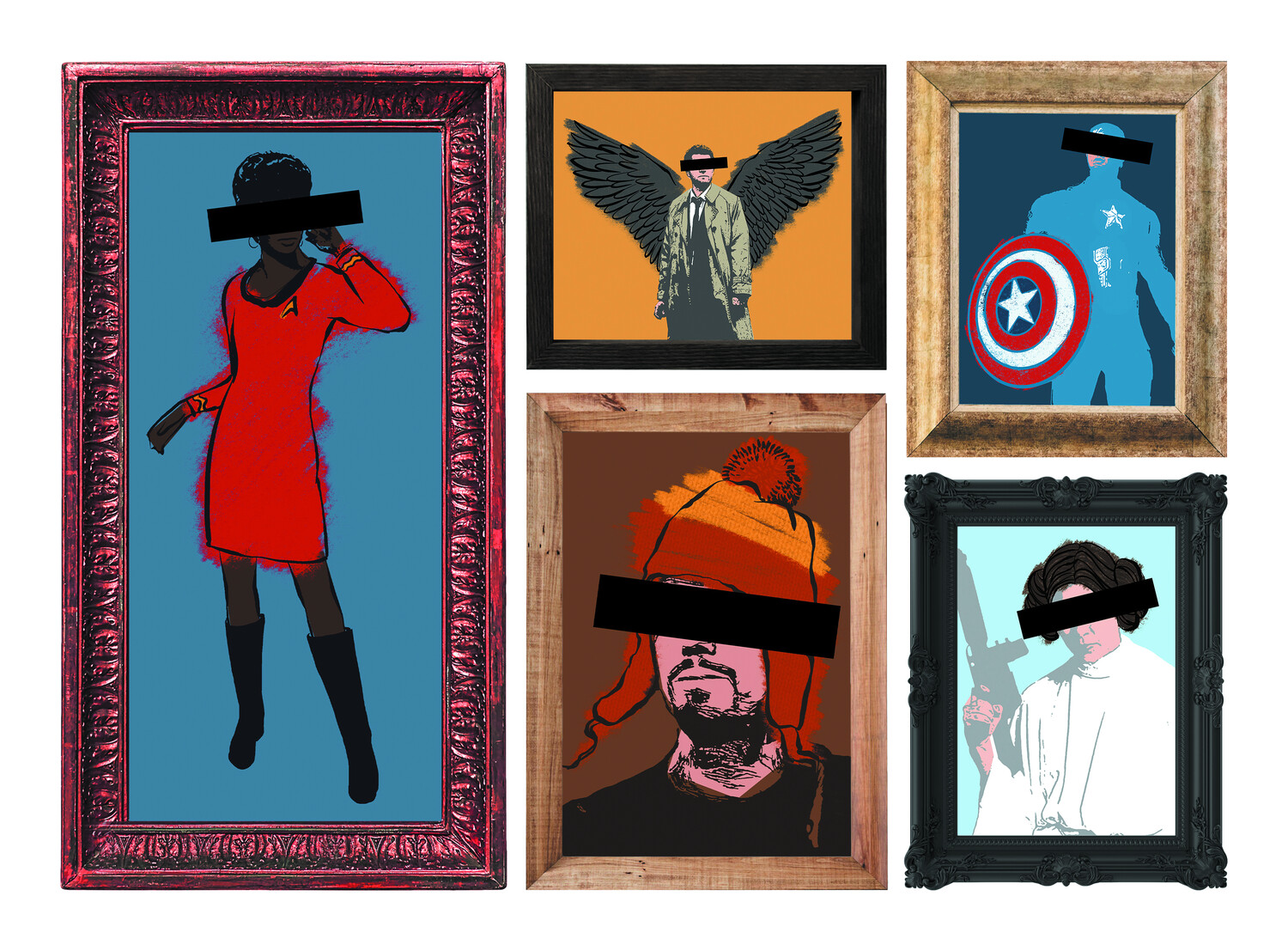
Mary P. Traverse—a self-described artist, designer, loudmouth, and nerd—is very much one of those people. She came to fan art early and never really left. When asked how long ago she got started, she said, “I’ve been doing fan art for so long now that it’s hard to remember.” As a kid, that meant drawing My Little Pony characters and replicating places her family had visited with Legos. Later in college, it meant realizing that what she was doing had a name—and a stigma attached to it. “There’s this idea that fan art isn’t real art,” she said. “Like you’re using other people’s ideas for your own inspiration.”
That argument never sat right with her. “If you want to get grandiose about it,” Traverse said, “everybody draws inspiration from each other. A bunch of John Williams music is fan art because he draws very directly from other well-known pieces.” And that extends to classical art—saints, Greek gods, Biblical stories, everybody just drawing the same characters over and over again. Modern fandoms, in her view, function the same way. “Star Wars, Marvel, Harry Potter—that’s our mythology now.”
Traverse sells art online, including some fan art, which means dealing directly with platforms and takedowns. One of her most popular designs—a shirt inspired by the “Defiant Jazz” episode of Severance—sold around a hundred units before it disappeared. “That’s when I started getting clever with my tagging, like Spirit Halloween costume names,” she said, laughing. Jangles the Moon Monkey from Fallout became “wasteland-themed lunar primate.” What We Do in the Shadows characters turned into “Staten Island’s favorite housemates.”
Some IPs and fandoms, Traverse said, are more openly welcoming than others. “Supernatural and Our Flag Means Death,” she said. “Those casts love fan art. I did fan art of Leslie Jones in Our Flag Means Death, and she reposted it on her social media.” Supernatural even built an episode around fan fiction. But other companies have learned—sometimes publicly—that aggressive enforcement can backfire. Traverse brought up the Etsy knitter who made Jayne Cobb hats from Firefly and received a cease-and-desist, after Fox had already pissed off fans by canceling the show. “That did not go well,” she said.
Traverse doesn’t see fan art as neutral. Around 2016 and 2020, she made political work that used original sources in new contexts. “I did a series of acrylic vignettes that were the Captain America shield, the Songbird from The Hunger Games, the silhouette of the Serenity ship—all properties that had a message of banding together as people, not letting the bullies win.”
“There was a whole project called the Hawkeye Initiative,” she said, “redrawing male superheroes in the poses and costumes that female superheroes were always posed in—one person did a drawing of Hawkeye, and it became this grassroots thing.”
“It’s a vocabulary,” Traverse said. “You’re using characters people already know to say something they weren’t expecting.”
+++
Emerald City Comic Con, the massive comics and pop culture convention, takes over the Seattle Convention Center and much of downtown every spring. Close to 100,000 fans pass through, along with artists, publishers, actors, and anyone else orbiting modern fandom.
Where do people go when they first get to ECCC? Almost everybody I asked gave me the same answer.
“Artist Alley,” Marzette Mondin said, no hesitation. Mondin has been going to ECCC for more than ten years, almost always with her friend Tiffany Jessup. Both are dedicated fan-art collectors.
“That’s where we spend a lot of our time,” said Jessup. “That’s where all the fan art is.” They’re drawn to some of the same things (sci-fi, strong female characters), but with very particular preferences. Mondin is most passionate about Star Trek: The Original Series, while Jessup veers more broadly sci-fi/horror/pop culture (Buffy, Firefly, Agatha, now Pluribus, and even The Great British Bake Off). She says she once tried to track down ninth-series GBBO contestant Kim-Joy at her booth but found her wandering the floor with a parasol because, as Kim-Joy put it, “It’s too much for me, honey. I need to take lots of breaks.”
They describe the main exhibit hall as big, impersonal, and mostly the same every year, with different franchises rotating through the spotlight. Artist Alley is the opposite: The artists may return, but the work keeps changing. Spend a little time there and you start recognizing tables and styles before you recognize names.
Mondin has been going to ECCC long enough that those patterns feel obvious now. “I really love getting to know the artist and their story, seeing them become successful,” says Mondin. “It’s thrilling to me.” Collectors come back and the artists remember them. Sometimes, that means a short conversation. Sometimes, it means an artist pulling out a print from behind the table because they remember you asking about it online.
Buying art is still the point, but the appeal isn’t just the object. It’s everything around it: shared nerddoms, watching an artist’s style shift, noticing which characters they return to, sometimes realizing you’ve followed them longer than you’ve followed a favorite show.
Both Mondin and Jessup talked about bringing their kids along for years. They’d split their days—some driven by the adults, some by shared family interests, some by whatever their kids were into at the moment (e.g., Halo, Mouseguard, My Hero Academia, Magic: The Gathering). For a long time, the kids didn’t think much of it; Comic Con was just somewhere they went. Only as they got older did they understand how weird it was to meet the people who made the things you love. “They didn’t realize how privileged they were,” Mondin said.
Artist Alley never explains itself. It assumes you already know the source material—and that you want to see where else it might wander.
+++
In conversations about what fan art is, visual fanfic kept feeling like the right analogy. (If you haven’t heard of fanfic, where have you been since Spock started making out with Kirk or the evangelical adaptations of Harry Potter?) Fan art isn’t official and isn’t pretending to be, but it deliberately takes on a character or world and spends time with it on one’s own terms.
Jessup talked about it in a practical way. “Something I love about [ECCC] is that there’s art for everybody. Probably more than half of it is not my speed, but when you find something special that you resonate with, you’re like ‘I just have to have that.’” It’s usually because an artist has made a choice she recognizes: a character framed differently, or treated more seriously, or allowed to look powerful without being sexualized.
This is also why official art mostly doesn’t do much for her. “I don’t want to buy a movie poster,” she said. “That’s not interesting.” When she wanted something signed by director Mike Flanagan, she didn’t bring an official Haunting of Hill House poster. She went on Etsy and found a fan-art poster instead. Flanagan hadn’t seen it before. He loved it. His wife (actress and collaborator Kate Siegel) loved it. They asked where she got it. And in a classic fan-art moment, the unofficial thing became the thing worth talking about.
People who study media sometimes call this participatory culture—the idea that audiences don’t just consume stories but actively reshape them. Artist Alley makes that abstract idea literal. You hear people debate which version of a character feels right, you see every kind of mashup—Captain Kirk in an old-school screen-printed boxing-match poster, Drummer from The Expanse with old Western heroine vibes, Nadja of Antipaxos as a prayer-candle saint. It’s commentary and conversation—people messing around with stories they know by heart.
+++
If that’s what fans see when they walk Artist Alley, the artists behind the tables see many of the same things from a different angle. Valentine Barker is a working artist who has been making and selling art at cons long enough to have opinions about why fan art exists in the first place.
He started tabling in 2012, at the first Rose City Comic Con. “I made, I think, like $15 in profit,” he said. “But I had a lot of fun. So I was like, I’ll do another one, and then another one. I was working a day job that was shutting down, and I took a look at my numbers. I was like, I can either do more cons and have that be my job, or get a new job.” Over time, those early experiments turned into something more systematic. He learned which shows worked, what people responded to, and how much he wanted to devote exclusively to his own creations.
“Looking back over my career as a convention artist, less than 10 percent of stuff that I’ve ever had on my table has been fan art,” Barker said. “Which I’m actually very proud of.”
For Barker, fan art plays a business role. “It draws people to the table,” he said. “They come because they see a character that they like, and then they take a look at everything else, and they walk away with more of what I do.”
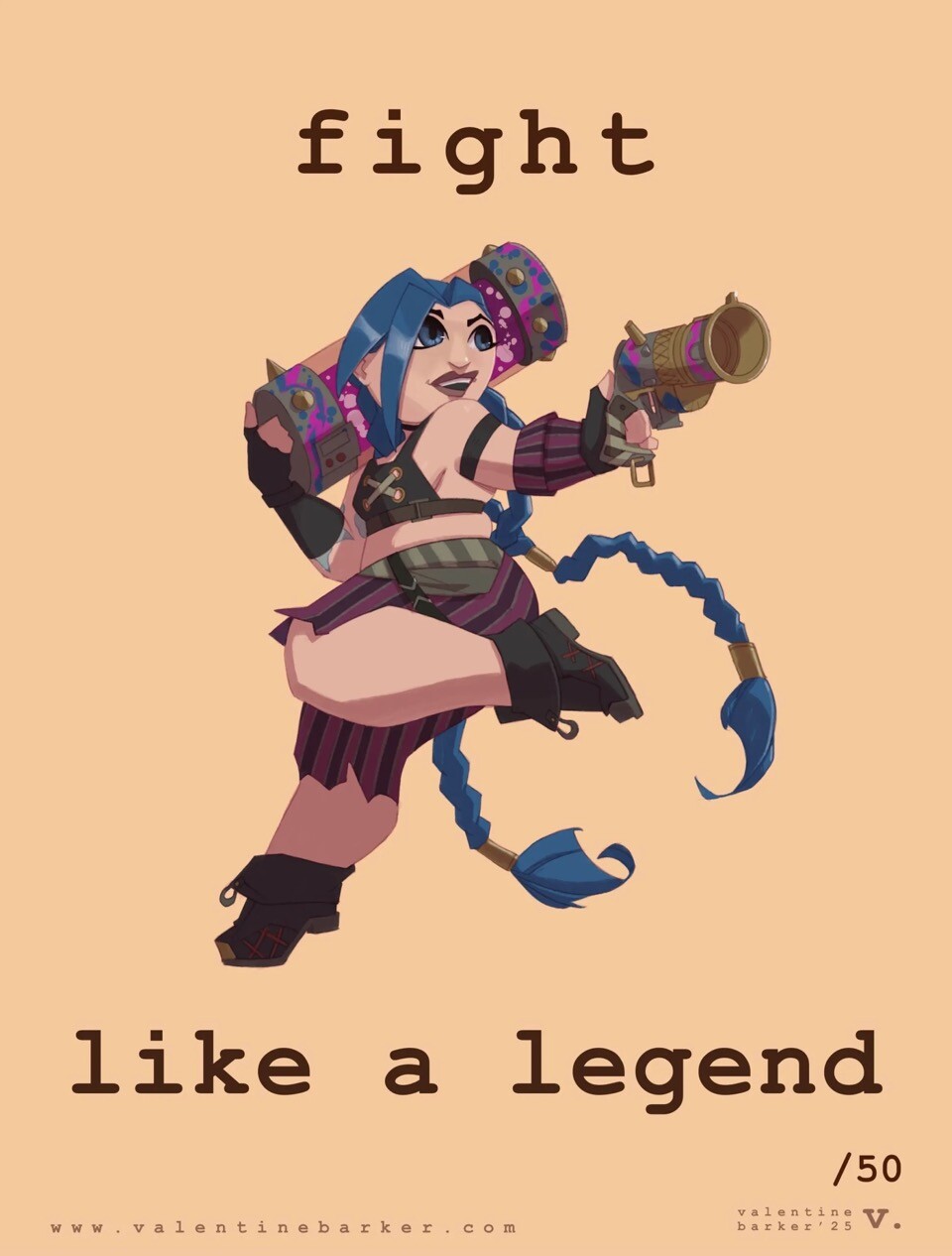
But fan art can just be fun, too. “There’s stuff I really love—like the Arcane characters—that I’m, like, I have to draw them and see what they would look like in my style and just have fun with it,” he said. “But I also do fan art as limited runs, usually of 50 to 100 prints.”
Barker traces a lot of the growth in fan art to the way comic culture went mainstream, especially through the Marvel Cinematic Universe. “I actually think the MCU played a huge part in that,” he said. “All of a sudden, comic books and general nerdery became more mainstream. You don’t have to know all of Iron Man’s backstory to enjoy Iron Man.”
That shift, he said, made fan art more accessible for both audiences and artists. “I feel like it’s a very valid entry point for a lot of people,” he said, himself included. New releases create moments of shared attention, and artists respond to them. Barker talked about riding those waves. One year at ECCC, he made a triptych of Captain Marvel, Ms. Marvel, and Monica Rambeau, each print labeled with one word from the film’s tagline (taken from the arcs in the original comics): Higher, Further, Faster. “The movie had just come out,” he said. “And I was like, oh, this is a perfect time to do these three. And it was a lot of fun.”
Among his peers, Barker sees a similar approach. Many are working artists like him, often in comics or traditional publishing, who make fan art for properties they genuinely care about. “A friend of mine did a piece of Tim Curry as the Devil. Which is beautifully rendered, but it’s from an ’80s movie. It’s not like people are knocking down doors to get this; she just did it because she loves it,” he said. “They’re like, ‘If this fan art piece doesn’t sell, that’s fine. I’m mostly here as a way to advertise.’” It isn’t about chasing sales so much as signaling taste—to audiences, peers, and themselves.
+++
Artists talk about fan art in terms of style, audience, and timing. Lawyers and people immersed in IP law talk about it differently.
Ryan Dancey is a former vice president of Dungeons & Dragons at Wizards of the Coast and one of the architects of the Open Gaming License, the legal framework that allowed third-party creators to publish material compatible with D&D. He’s spent decades thinking about what happens when companies loosen—or tighten—their grip on intellectual property.
“Unlike a lot of law, copyright law is mostly determined by litigation and court decisions,” Dancey says. “The law itself, Title 17, is actually pretty small and straightforward.”
That means the rules shift when courts reinterpret them. He pointed to the Supreme Court’s 2023 Orange Prince decision, involving Andy Warhol’s silk screen portrait based on a photograph of Prince. For years, artists relied on the idea of “transformative use”— that changing context or meaning could qualify a work as fair use. The court greatly narrowed that reasoning. “So right now,” Dancey says, “transformation is not a great argument to make.”
That doesn’t mean fan art suddenly became illegal; it just makes the fair-use argument more complicated.
“Fair use says, ‘I am infringing your copyright. I am. I’m not even going to pretend that I’m not,’” he said. “What I’m saying is, ‘I have the right to do that.’” One of the most durable versions of that argument is parody. “Parody is a very protected form of expression,” Dancey said. “Courts have stopped trying to define what’s funny. Instead, they’ve kind of fallen back on intent.” If the work is recognizably making fun of something—if an average person could encounter it and say, “Oh, that’s a parody”—then the artist is likely to get the benefit of the doubt.
He rattled off examples: Mad Magazine, National Lampoon, Robot Chicken, Family Guy. “It’s all parody,” he said. “And it’s completely okay.” Cartooning, he added, often falls naturally into that territory, being exaggerated by its nature.
And commercial intent doesn’t undo that protection. “A lot of people think there’s a commerce aspect to copyright, and there really isn’t,” Dancey said. Selling a parody doesn’t automatically disqualify it. And in a landscape where transformation has become less predictable, parody remains one of the sturdier arguments available.
+++
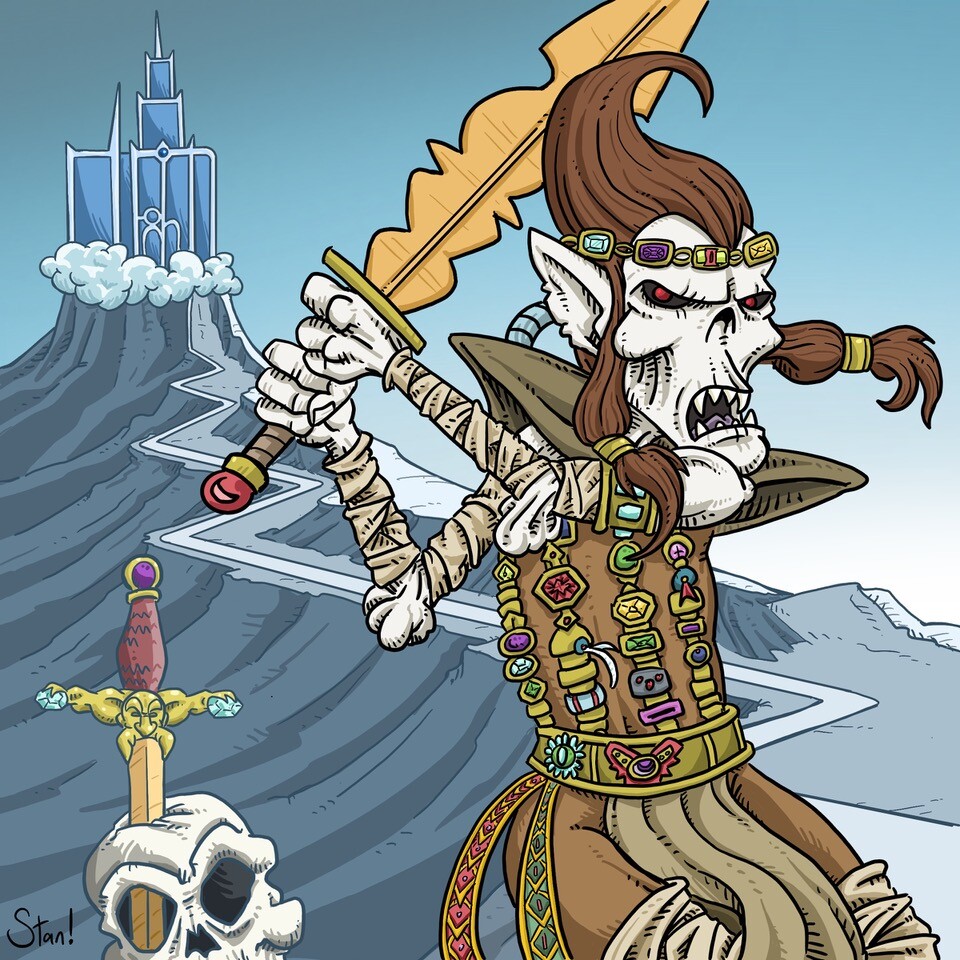
What that looks like in practice depends on the artist. Stan! (artist Steven Brown) has been drawing role-playing game art for almost as long as there have been role-playing games to draw. His YouTube series “50 Years in the Dungeon” celebrates Dungeons & Dragons’s 50th anniversary. On the livestream, he sketches his own interpretations of classic D&D book covers, while interviewing luminaries and insiders from every era of the game—from Jeff Grubb and Tracy Hickman to Monte Cook and Peter Adkison. He was lucky enough to get one of the last interviews with Jim Ward before he passed away. “I did one from each year of D&D,” he said. “So I started with 1974, and over the course of the year, I’d have a different guest on. While we talked, I would do a drawing from the next year, all the way up to 2025.”
Each classic cover is filtered through Stan!’s cartoony style. The dragon on the 1977 D&D Basic Set looks a little more like a goofy Zorak from Space Ghost; the githyanki on the 1981 Fiend Folio remake feels more annoyed (and possibly stoned?) than menacing. If you know the originals, you see the references immediately. If you don’t, they still work as sweet, 1970s-fan-art-adjacent fantasy scenes.
He’s shown the originals, and people love them. But he hasn’t turned them into prints. The hesitation is the source material. Even those early covers, created for D&D’s original publisher, TSR, Inc., belong to someone—and Stan! has no interest in becoming the person who finds out exactly where the fair-use line lies. “The real problem in any of this isn’t really whether or not a case would be winnable,” he said. “It’s that, if the company wants to make legal trouble for you, you as an artist can’t afford to fight a claim that you might win.”
So the drawings live in this slightly strange state—finished, admired, instantly recognizable to fans, but not available for purchase.
If you spend time in Artist Alley, you start noticing how many decisions like that probably happen quietly. Artists doing limited runs, renaming titles, and avoiding certain IPs. Some artists push, others hedge.
Mondin doesn’t think about any of that.
“Fan art is like art about something that I care about with a little twist on it,” she said. “I feel like I’m part of this unique group that gets to have special access to something that regular people don’t have access to—so it’s like a prized possession for me. And I love supporting these artists.”
Her most prized find? Her go-to necktie, in subtle gold lamé, hand-painted with an image of Lieutenant Uhura from the original Star Trek. “I found it my first time going to Comic Con, and I think that’s what hooked me and keeps me going back,” she said. “It was like finding a treasure because I never saw one for sale again. And everyone’s like, ‘Oh my god, I’ve never seen anything like that.’”
Wearing it over the years, the tie has become even more meaningful in conversations with other fans.
“Then one time, someone told me that they had the same tie, and the actor, Nichelle Nichols, signed it,” she said. “I remember that being before she passed but knowing that her health wasn't so great—we realized how special the tie was to both of us.”
