PINK ROCKETS, REAL TALK: CATCHING UP WITH TARIQA WATERS
From Pioneer Square to SAM to wherever the work takes her next

PINK ROCKETS, REAL TALK: CATCHING UP WITH TARIQA WATERS
From Pioneer Square to SAM to wherever the work takes her next
When Tariqa Waters graced the first-ever cover of PublicDisplay.ART in December 2021, she was running a gallery in Pioneer Square while navigating pandemic-era isolation and the weight of being a Black artist in Seattle. Four years later, she's redirected that pressure into becoming an undeniable cultural force, now with a Betty Bowen Award, a solo show at Seattle Art Museum, a book that flips art world etiquette on its head (Who Raised You?, Minor Matters Press), a television show (Thank You, MS PAM), a painted public crosswalk, her standing Ask MS PAM advice column in this very maga- zine, various other curatorial projects and museum exhibits—and the list goes on. More than any single achievement, Waters has demonstrated her ability to create and maintain her presence, whether solo or in collaborations, across Seattle’s art scenes—operating at the intersection of pop art's brightness and punk's refusal to play small.
After more than ten years of seeing Tariqa make moves, I can attest that she makes it look easy, as if these larger-than-life works just pop out of her head and into reality. I've never seen her sweat. In every conversation we’ve had, she's genuinely hav- ing a good time weaving experiences together with a wicked sense of humor and zero wasted words. She's a storyteller through and through. Speaking with her is like listening to a well-curated mixtape, each track flowing into the next until you've traveled through her memories and landed with the full story in your hands.
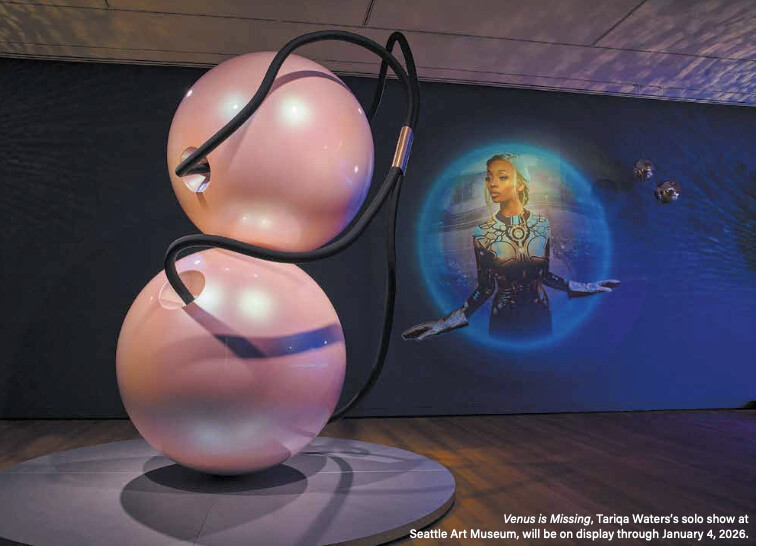
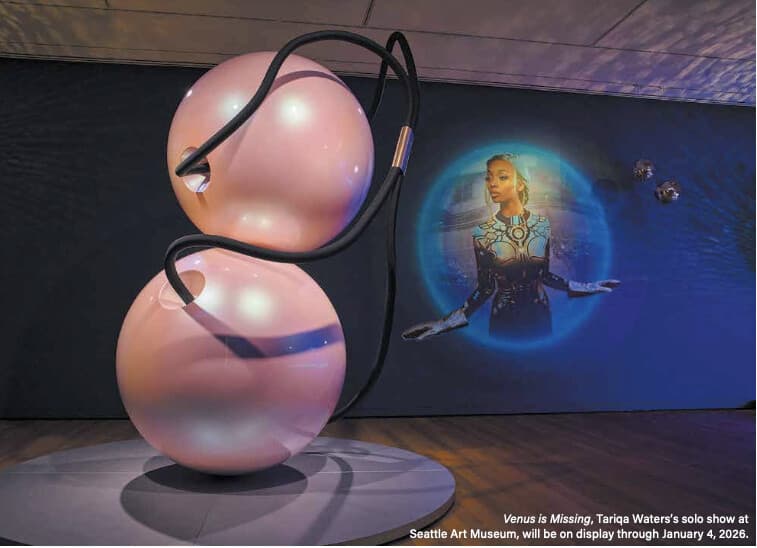
Venus is Missing, Waters’s first solo exhibit at Seattle Art Museum, is a retro-Afrofuturist¹ dreamscape where childhood artifacts become cosmic technology. Past the second floor, beyond the wall of Warhol portraits, a silver beam pools into a circle of light—less spotlight, more teleportation chamber. Step in, and reality shifts. Inside, gigantic disco ball lights swirl around a seven-foot-tall bubblegum-pink ball barrette, Hold Tight. The focal point is Future to the Back, a candy-pink rocket ship surrounded by blown glass baubles. One large image is affixed to the wall: In it, a young woman (Waters’s daughter) wears a futuristic suit before a sepia-toned photographic back- ground. Waters imagines futures where transcendence was always present in the everyday objects of Black girlhood.
In her first book, Who Raised You? (2025), Waters pres- ents an account of her philosophy of art, her approach to living, and the characters who have shaped her. It functions as an artist's survival manual, a memoir, and a tongue-in-cheek etiquette guide. "I feel like now, I have the opportunity to talk about the folks who raised me, and the subversive, satirical elements could be a nod to what I experienced professionally as an artist," Waters says. The book opens by addressing white supremacy head-on, then pivots through personal history, pop cul- ture, and the people who made her who she is. "Espe- cially as Black women, we need to tell our story. Peo- ple enjoy forgetting our contributions in every fucking thing," she says. "There's a burning in me to archive a time in Seattle, especially in Pioneer Square, where the thing actually did happen." This book serves as a form of insurance against the art world's amnesia regarding Black artists.
Waters moved to Seattle in 2012 with her partner, Ryan Waters, a star guitarist who has played with Prince, Sade, and Liv Warfield, among other iconic musicians. They arrived with their two kids, 9 and Kaelau, stum- bling into Pioneer Square during Art Walk. With a new lease and bills rolling in, Waters took a job in the Seattle Art Museum's gift shop. "I knew that, at some point, I'd have a solo exhibition here," she prophesied. Once established in one of Pioneer Square’s signature brick buildings, Waters quickly started building her pop art playhouse. This era marked the opening of Martyr Sauce, an underground (actually below-ground) beauty shop and art gallery. These spots rapidly became a hub of the Pioneer Square First Thursday Art Walk, the hottest place for the young, Black, and fly. Patrons, friends, and neighbors embraced the family, but it wasn't until the pandemic that it received recognition. "It wasn't until then that the Alliance for Pioneer Square was like 'Thank god you're here, what can we do?' I was like ‘Where was this in 2018?’"
Waters has always been clear about what she brings to the table and what she needs in return. She is firm about how to navigate art spaces that weren't built with Black artists in mind: "I don't have anybody who's going to advo- cate on my behalf. It's just going to be me, and I've aspired to be here in this way, and this is what it's going to look like." Her self-possession shows in how she approaches every opportunity. It's a stance every artist deserves but few get the room to occupy: showing up as yourself, full stop, with clear boundaries and zero apologies.
"I'm expensive,” Waters says. “So if you call on me, don't think I'm just grateful to be here." It's not a flex; it's a fact. Artists are expensive, and institutions continue to receive the discount rate because artists have been conditioned to accept gratitude as a form of currency.
In this new era, Waters is hitting her stride. She’s split- ting her time between Seattle and Atlanta, keeping her options deliciously open, and following the work wherever it leads. She’s hinted that Thank You, Ms Pam may return with new episodes, and she’s continuing her mission to get money into artists' hands while creating a blueprint for fairness between artists and institutions. Tariqa is unequivocally too fly for compromise, too necessary to wait for permission, and too busy building a bubblegum-pink future. So step into the beam. Venus is Missing runs through January 5, 2026, at Seattle Art Museum. Read Tariqa Waters's Ask MS PAM advice column in every issue of Public Display.ART magazine.