
In high school, there was a bus called the Big Red Bus. You could get on it and give blood for 20ish minutes and get a grocery-store cookie afterwards. Most importantly, you got to skip class if you were giving blood, so suddenly the Big Red Bus was the place to be. Everyone wanted to give blood. Plus, you got to wear a little cotton ball with some colorful tape over it in the crook of your arm for the rest of the afternoon, like look at me, I gave blood. Not that giving blood was so cool, but in high school, when a few people had something stuck to their bodies, everybody else wanted it too.
Naturally, I got on the Big Red Bus. My friends were all skipping class, so I skipped class too. I had never given blood before, and the mechanics of it didn’t really cross my mind until I got on the bus and saw rows of my classmates with tubes coming out of their arms, right where the cotton ball tape scenario would soon be. And the tubes were red and piped into bags that were filling up, red and squishy.
The red bags made my palms sweaty, but I was already inside the bus giving the nurse my name and date of birth. She told me I had to wait a bit, and sat me down. The waiting wasn’t ideal because I started thinking more and more about how there was blood inside the tubes going into the bags and the bags, which looked like slippery seal pups, were filled with the same blood that was inside my classmates and inside me.
When it was my turn, the nurse hooked me up to a heart rate monitor. Apparently, you can’t give blood if your heart rate is too high or low. I watched my number on the screen as it shot up into the hundreds. It was like my awareness was a motor: the more I thought about my heart rate, the faster it went. I pictured my heart pumping inside me, so close to me and the nurse but also functioning on an entirely different plane of experience than the highly cerebral one where my teenage consciousness dwelled. This number on the screen was borne of earth and blood and tissue, and it was not used to being observed.
After a few rounds of taking my pulse and little success in bringing it down below the one hundred mark, the nurse informed me that I would not be giving blood today. I knew this of course, and might have even known it from the moment I stepped foot on the bus and saw the squishy sacs of my classmates’ blood. I can’t remember now if anyone thought to give me a consolation cookie.
Last Friday evening, I walked across downtown to Actualize AiR (located in the former Banana Republic building) for their open studio night. It was 6 p.m., and the studios were supposed to be open from 6-9 p.m., but I was deeply aware of how early I was in a social sense.
I was hoping to test out Reality Massage, an interactive installation sprouted from the mind of Actualize co-founder and artist Kate Bailey. I didn’t know too much about it, just that I would put something on my head, and it would, well, massage my reality. I’ve always pictured taking my brain out of my skull and rinsing it under cold water, or letting it air out on the windowsill, or at least just getting it the hell away from me for a bit. From what I saw on Instagram (video here), a Reality Massage would facilitate those feelings, in some way or another.
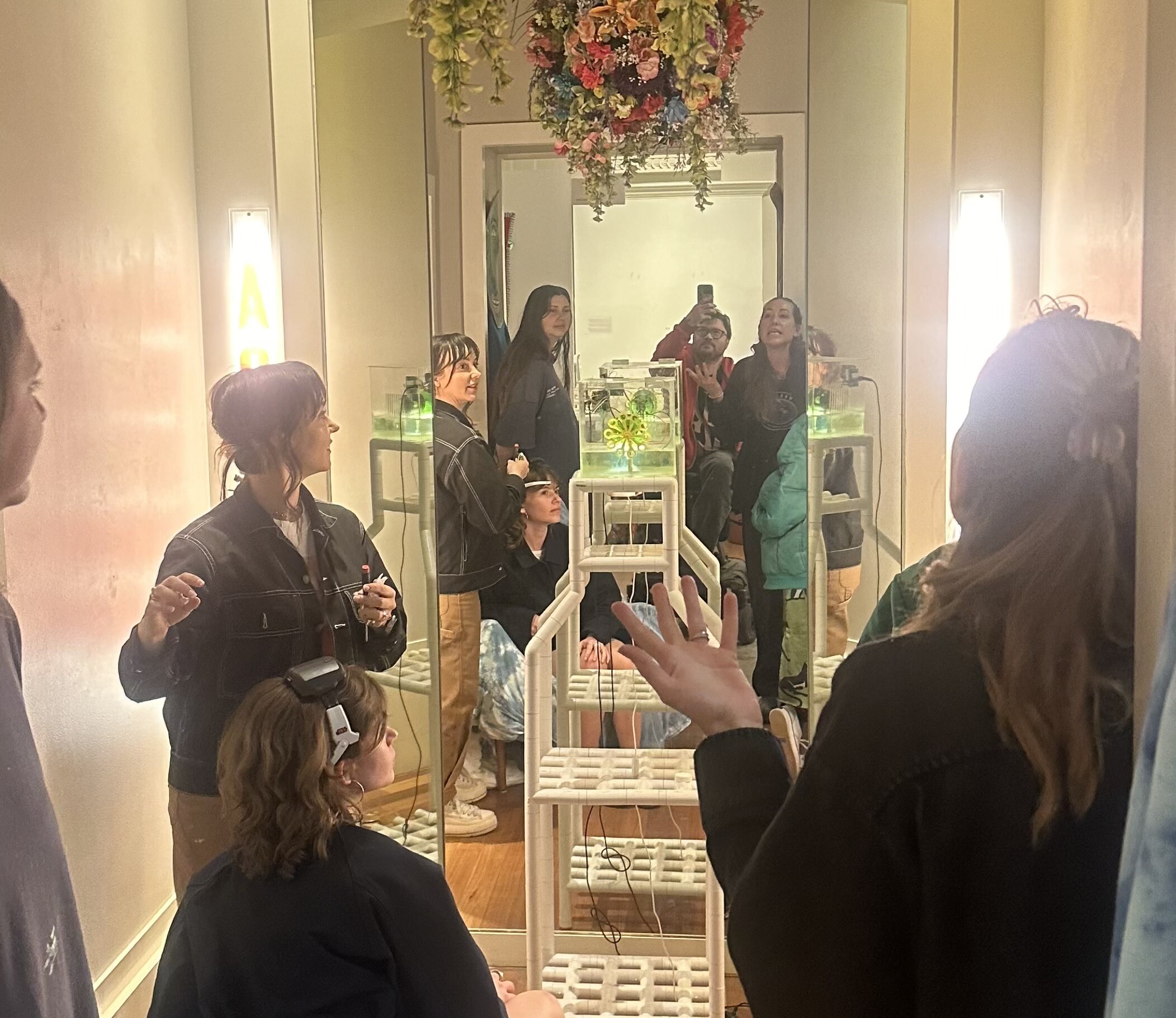
Reality Massage was tucked away in a cozy little vestibule at the back of the Actualize space, situated across from Bailey’s studio. The vestibule was lined with those sort of tri-fold mirrors you find in a T.J. Maxx dressing room, in which you can look at your butt from angles typically reserved only for strangers and God. A chair was positioned facing the mirrors, a blue and white tie-dyed blanket draped over it. To maximize relaxation, presumably.
The pièce de résistance of the operation was the white plastic tower constructed from PVC fittings upon which sat a plexiglass cube filled halfway with a murky liquid (bubble solution, it turns out). Inside the cube was a frankensteined bubble-blowing creature made from ten individual bubble wands pieced together in a circle like a benevolent Eye of Sauron. The wands were spinning, bubbles pumping out and filling up the vestibule. A woman, seated in the chair with the blanket beneath her, was grinning at the bubbles. Apparently, they were coming from her brain.
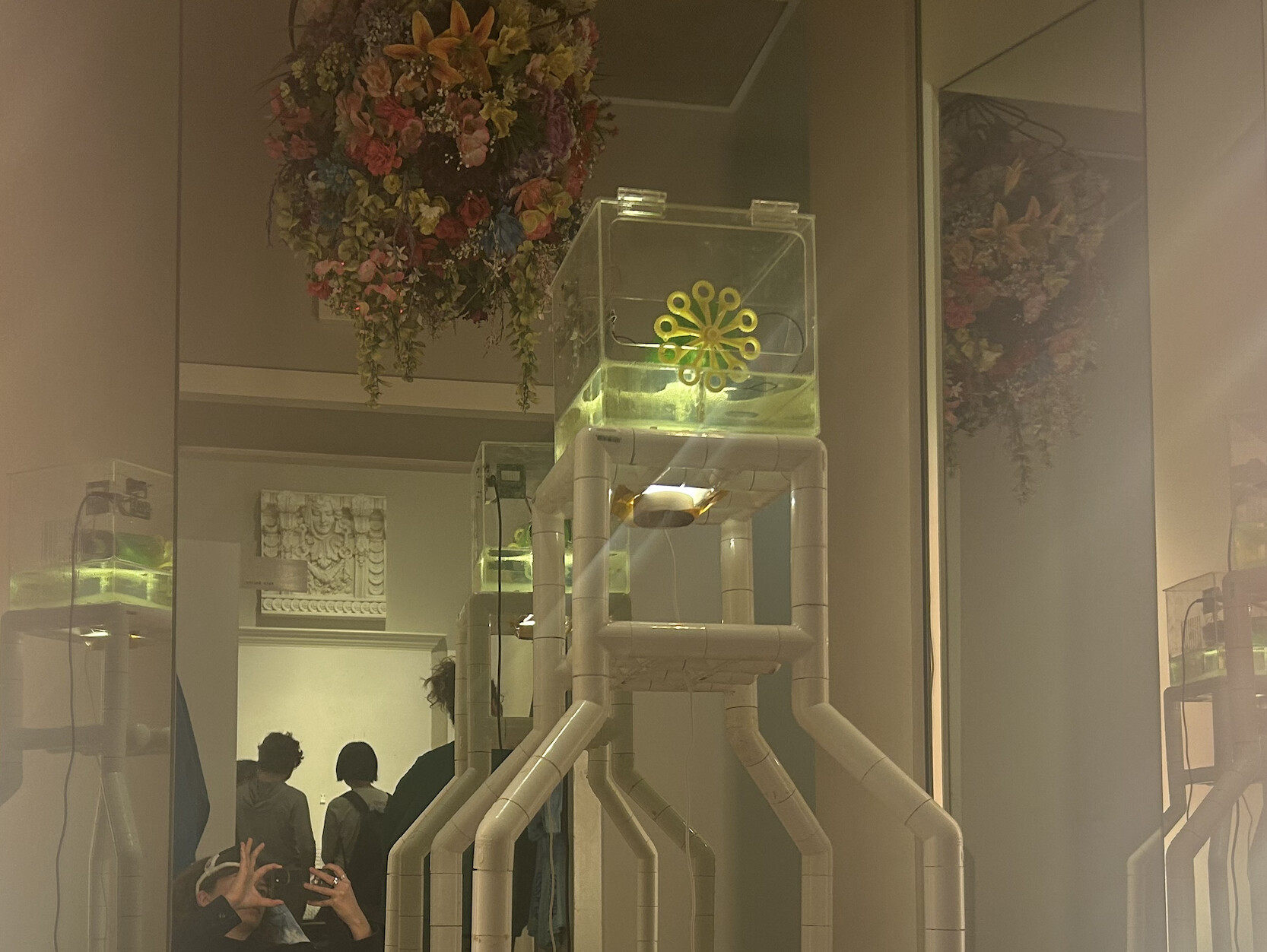
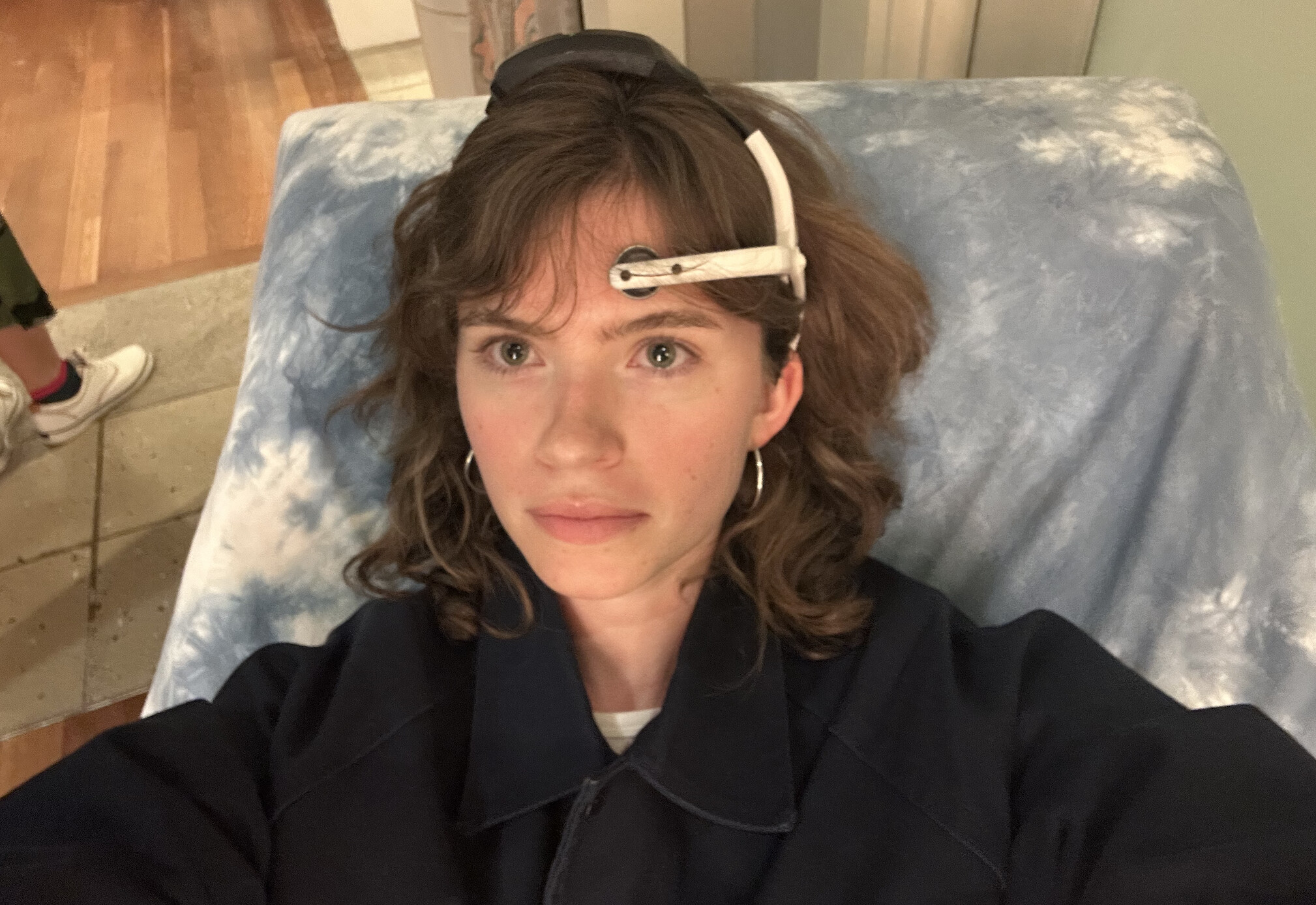
She got up, and it was my turn. Bailey sat me down in the chair. I peered at myself in the T.J. Maxx mirrors and had Pavlovian thoughts about my butt shape. Her assistant for the night, makeup artist Kaija Towner, fastened a headset onto my head; it was equipped with three prongs: Two that would sit on the back of my neck behind my ears, and one for my forehead. Towner made sure the prongs were touching my skin directly, and explained that the bubble wand contraption would begin to spin and blow bubbles based on my concurrent levels of relaxation and focus. If I was relaxed enough, but also focused—not totally zoned, but present and aware—my brainwaves would reflect this and I, too, would create bubbles with my mind.
I took a sip of my art walk wine and thought about the Big Red Bus and my inability to get that number down. Bailey invited me to sit back in the chair and get comfortable. I guess I was looking quite stiff, perched primly upright like I was taking a test. I had the beginnings of an anxious feeling; would I be able to produce bubbles? What if I sat here for the rest of the evening, in a fierce stare-off with the ten-eyed monster before me?
I slumped back in the chair with mock nonchalance and braced myself for the long haul. Five minutes went by, and then seven. I had the paranoid thought that Bailey and Towner were sharing concerned looks behind me, as bubbles were nowhere to be found. I concentrated on relaxing as hard as possible. Other visitors roaming the open studios poked their heads in, curious to see what was happening in the mirrored vestibule. I asked Bailey how long it had taken the woman before me to produce bubbles. “Immediately,” she said. (But everyone was different, she assured.)
A few years ago, I downloaded one of those meditation apps on your phone that teaches you to “watch your thoughts pass by like clouds without judgment.” I remember something the man said—it was always a man narrating these apps—about meditation being the absence of effort. In the vestibule, I closed my eyes and tried to stop trying, like he had told me. Can you try not to try? I thought about whether it was possible to stay too long at the fair.
In the end, I produced bubbles when I was the most distracted from the task. In the midst of talking and laughing about the difficulty of becoming zen, it finally happened: I became zen. I became the bubble mother. I forgot about the headset on my head and managed to achieve the precious equilibrium of relaxation and focus, marveling at my bubbles. I took a video and then a selfie, at which point even more bubbles came forth, jubilant. Did the image of my face on the screen happen to align my chakras? Is selfie-taking a salve for the overthinker? Maybe the whole time on the Big Red Bus I just needed to pose for my phone. Either way, I left Reality Massage satisfied with the knowledge that I could, in fact, get over myself, or beyond my self, or into my selfie enough to reach a place of not trying to try so hard. And that’s how the bubbles get made.
Curious to try Reality Massage for yourself? Follow Kate Bailey and Actualize AiR to be alerted the next time it’s up and running. In the meantime, head to Actualize during the Downtown Art Walk (fourth Fridays) to explore the open studios.
