An 1890 brick landmark on 1st Avenue, across from the Seattle Art Museum. It has been a Klondike hotel, a sailors’ tavern, a vice-era cinema, and, for one stretch, the Lusty Lady. Sealed since 2010. Andrew Conru bought the building in 2023 and is considering a major art venue here, to be announced later this year.
Built in 1890, one year after the Great Fire burned downtown to the ground, by architect William E. Boone, a direct descendant of Daniel Boone. Its fireproof brick and stone were the whole point: wood had just betrayed the city.
As the Hotel Vendome it sold respectable beds to Klondike-bound miners while psychics read palms downstairs. By the mid-1940s it was the Seven Seas Hotel and Tavern, a sailors’ corner run by “Mom” Avery, with a pistol range and a union hall stacked in the basements. In 1966 the entire northern half of the building was demolished. What stands today is less than half of Boone’s original.
For its final quarter century before closing, the ground floor was the Lusty Lady, the pun-slinging, women-run peep show that traded jokes with the Seattle Art Museum across the street. It closed in 2010 and the doors were boarded. A single panel went to MOHAI. We have the entire original sign.
Andrew Conru bought the building in 2023 and is considering a major art venue here, to be announced later this year. While the plans take shape the public is being let in. You walk through it the way the first visitors have: with a flashlight, and the original 1890 brick exposed to the air.
The Timeline
One corner, from 1890 to today.
The whole building in order. Colorized restorations of public-domain photographs, untouched black-and-white archival scans, and real photographs of the building now. Each is labeled for exactly what it is. Click any photo to see it full size.
c. 1890
First Avenue rebuilds, in brick
The world the building was born into. One year after the Great Fire of 1889 leveled downtown, First Avenue was a construction site of new fireproof brick blocks rising on a dirt street, the exact moment the Hotel Vendome went up a few blocks north. Wood had just betrayed the city, so everything came back in brick and stone.
First Avenue rebuilding after the Great Fire, looking through the new brick blocks of Pioneer Square. This frame sets the scene rather than showing the building itself.
1890s–1910s
The Hotel Vendome
Built in 1890, one year after the Great Fire burned downtown to the ground, by architect William E. Boone, a direct descendant of Daniel Boone. Its fireproof brick and stone were the whole point: wood had just betrayed the city. C. Sidney Shepard & Co. sold tin and aluminum ware at street level while the Hotel Vendome ran respectable rooms upstairs for Klondike-bound miners, with psychics reading palms downstairs.
The painted wall faces a dirt First Avenue. Look at the full width: this is roughly twice the building that stands today.
1908
The Hotel Vendome, from the water
The back of the same hotel, seen from the waterfront. The building steps three basement levels down the bluff toward Post Alley, where a pistol range and a union hall would later sit stacked below the street.
c. 1917–1920
The Hotel New Vendome
By the First World War the hotel carried a new name, the Hotel New Vendome. Soldiers march down 1st Avenue past it, the sign legible mid-block beneath a painted Coca-Cola wall. This is the building at its full original width, before the northern half came down in 1966.
c. 1917–1920
The same parade, the band
A second frame from the same parade: a military band on 1st Avenue, brass instruments out, the Hotel New Vendome sign and the Manhattan Cafe storefront just behind.
c. 1926
The Hotel New Vendome, remodeled
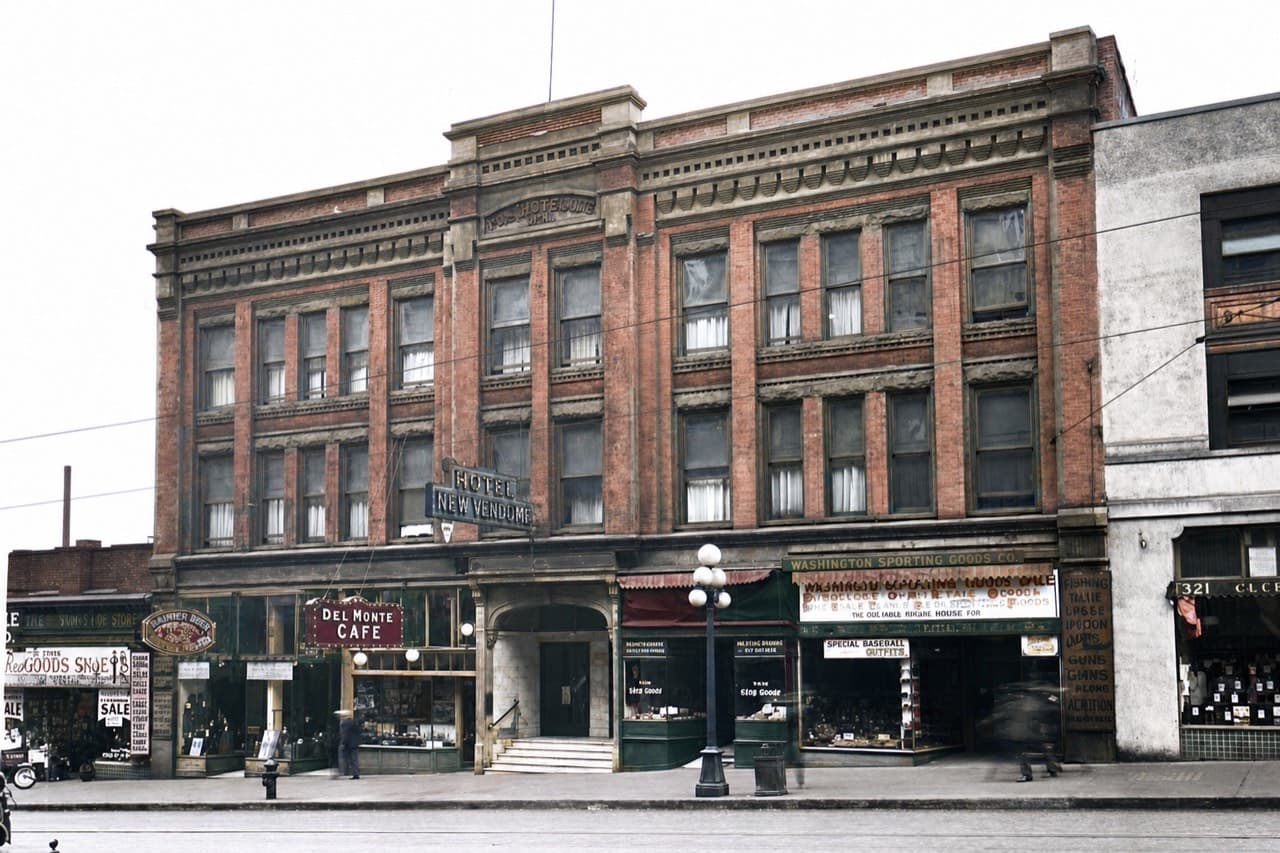
After the Bittman remodel, with the Del Monte Cafe and a sporting-goods store below. Everything left of the entrance was torn down in 1966; the marquee corner you know is the right half of this picture.
c. 1937–1941
The Hotel Vendome, full width
The closest verified mid-century photograph of the building, pulled from its own King County property tax card. The painted sign still reads Hotel Vendome, a Liquidating Sale fills the corner storefront, and the cars at the curb date the frame to roughly 1937 to 1941. This is the building at its full original width, before the northern half came down in 1966. A few years later, in 1945, the same corner became the Seven Seas Hotel.
King County tax assessment card for parcel 197620-0060, 1313-19 1st Avenue. Washington State Archives. Public domain.
1985–2010
The Lusty Lady
Between the wars and now came the Seven Seas Hotel and Tavern, run by “Mom” Avery, friend to sailors; then the Sultan Hotel and Cinema in the heart of the vice-era avenue. In 1985 the ground floor became the Lusty Lady, a women-run peep show whose pink marquee traded jokes with the art museum across the street for twenty-five years.
The real building in 2007, tan brick and the live pink marquee welcoming the Seattle Art Museum back to its renovated home across the street.
Today
Sealed, boarded, still standing
The Lusty Lady closed in 2010. A single panel went to MOHAI; we have the entire original sign. What remains after the 1966 half-demolition is three stories of 1890 brick, boarded and tagged, dwarfed by the glass towers that grew up around it.
Today
Across from the Hammering Man
The building sits directly across 1st Avenue from the Seattle Art Museum and its Hammering Man. The two have faced each other for decades.
Today
The back, toward Post Alley
The rear wall drops three basement levels down the old bluff toward Post Alley, the part of the building almost no one ever sees from the street.
Today
Inside, mid-restoration
The gutted main floor, with original timber columns and 1890 brick exposed to the air. You walk through it the way the first visitors do: with a flashlight, and the bones of the building wide open.
Colorized restorations are interpretations of real public-domain photographs (Wikimedia Commons, PCAD, MOHAI, University of Washington); nothing in any scene was added, removed, or moved, and the originals are one click away. Black-and-white frames are shown as untouched archival scans. The 2007 marquee photograph is by Joe Mabel, CC BY 2.5.
The Street As It Was
The whole block, in the Time Machine.
Our Seattle History project has colorized, narrated photographs of this exact stretch of 1st Avenue, from the 1870s to the 1920s. Step into the corner the building has watched for over a century.
These open the Occidental Seattle History archive. Its colorized photographs and short films cover the building’s first seventy years, up to 1962; the Sultan, the Lusty Lady, and today stay here on this page.
The Film
One block, one century, in motion.
4K film · coming
A 4K film of the building lives here.
This slot is reserved for the 4K Seven Seas film. It needs to be provided or commissioned; once the file is ready it drops straight into this frame.
Placeholder, not a finished asset. We have not auto-generated a video here on purpose.
The Lives
One building. Five names.
1890s–1910s
The Hotel Vendome
A respectable hotel for Klondike-bound miners, with psychics like Venus the Gypsy reading palms on the lower floors, satisfaction or no fee.
1940s–1960s
The Seven Seas
The Seven Seas Hotel and Tavern, run by “Mom” Avery, friend to sailors and a formidable bouncer. A pistol range and a union hall sat stacked in the basements.
1950s–1970s
The Sultan
The Sultan Hotel and Cinema, in the heart of what was then Seattle’s vice district, “Flesh Avenue,” while Plymouth Housing later restored the upper floors.
1985–2010
The Lusty Lady
For twenty-five years, a women-run peep show whose pink marquee traded jokes with the art museum across the street. It closed in 2010. A single panel went to MOHAI; we have the entire original sign.
2023–
Andrew Conru
Andrew Conru bought the building in 2023 and is considering a major art venue here, to be announced later this year.
Visit
Stand inside it before the restoration.
The Seven Seas Building is part of the Summer of Awe story. Lusty Lady tours are paused. The Coliseum is temporarily closed while we prepare Winter Lights. Tours resume with the winter show in late November. Tour times and the full calendar are coming soon.